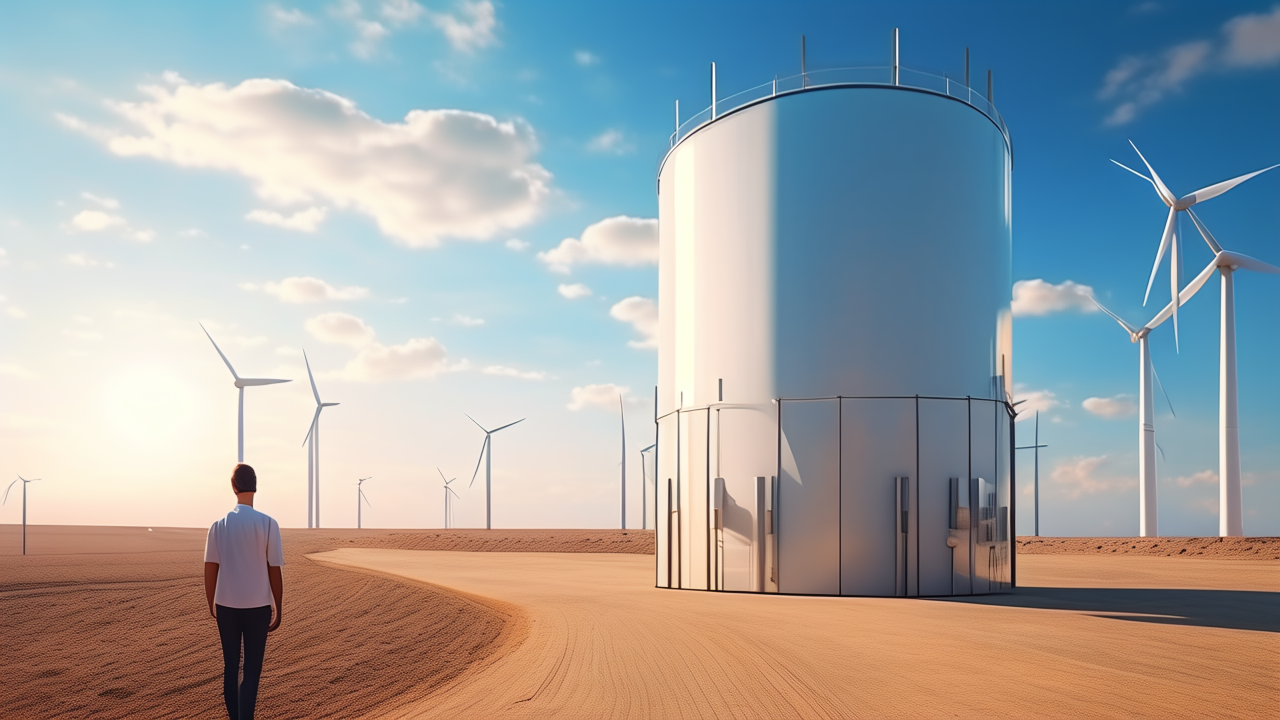
If you plan grids, develop wind and solar, run a data-center campus, or underwrite climate infrastructure, China’s newest long-duration energy storage (LDES) demo is worth a sober look. Around September 30, 2026, China Huadian’s compressed carbon-dioxide energy storage project in Mulei, Xinjiang was described as grid-connected — China’s first 100 MW / 1000 MWh-class plant of this type, and widely reported as the world’s largest of its kind.
It is not a lithium battery farm you can buy from a catalogue. It is a first-of-a-kind industrial plant that stores electricity by compressing and liquefying CO₂, then later gasifying and expanding it through turbines to generate power again — a closed loop, non-combustion cycle that does not need a salt cavern or abandoned mine.
What actually got built
Chinese reporting (Xi’an Jiaotong University, PowerChina, Xinhua, and the National Energy Administration’s Xinjiang bureau) converges on a few design numbers:
- ~100 MW power rating and ~1000 MWh energy capacity (the “100 MW / 1000 MWh class”).
- Design intent roughly ~7 hours to store and ~10 hours to generate — multi-hour LDES, not four-hour lithium.
- Projected generation on the order of ~200 GWh/year, with claimed savings of about 50,000 tonnes of standard coal and cuts of about 170,000 tonnes of CO₂ per year.
- Sited against Xinjiang’s wind-and-solar base; plans cited around the project point to a nearby renewables package on the order of 600 MW wind + 400 MW PV.
The working fluid is CO₂ in a closed loop: compress → liquefy → store in engineered vessels → gasify → expand → generate. That vessel-based approach is the headline for foreign planners stuck on geography: pumped hydro needs mountains and water; many compressed-air schemes need caverns. Mulei’s pitch is “tank farm + turbomachinery,” not “find the right geology.”
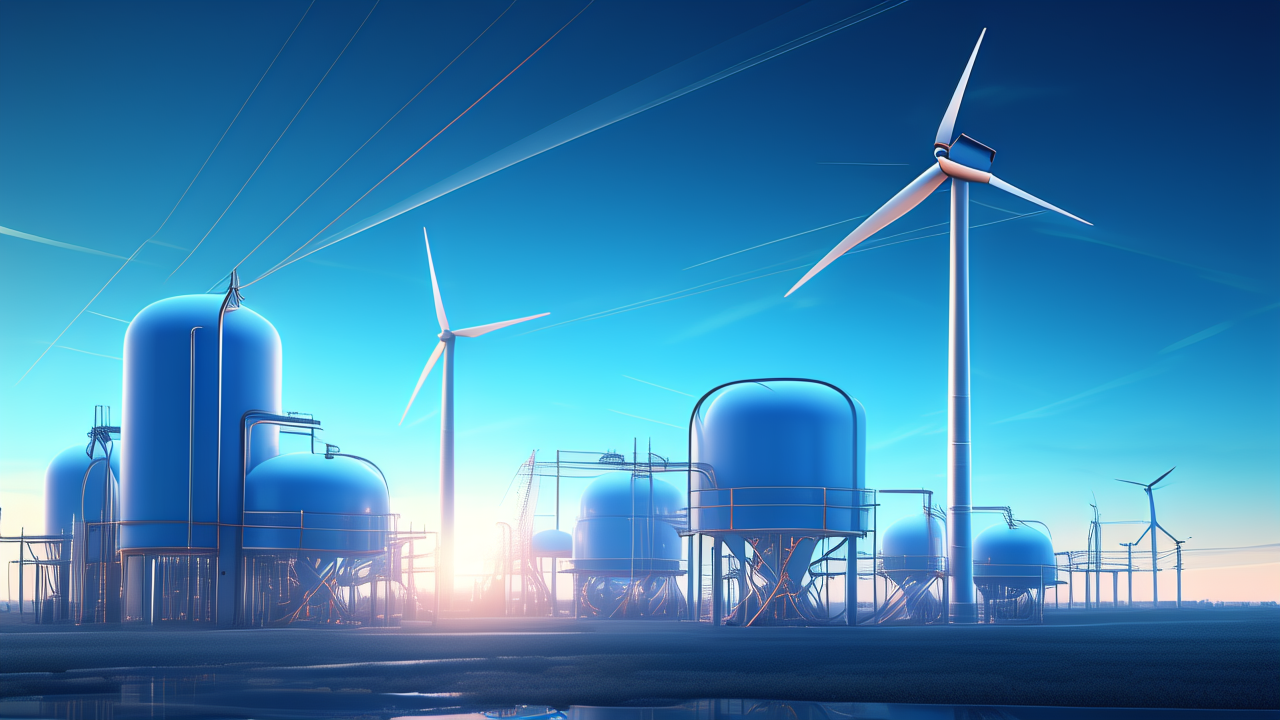
Illustration: vessel-based CO₂ storage tied to renewables — the cavern-free idea that makes this demo interesting abroad.
How it differs from pumped hydro and lithium LDES
Versus pumped hydro: you skip topography and long permitting fights over reservoirs. You still need heavy industrial equipment, safety cases for pressurized CO₂, and a site that can host large tanks and heat exchangers. Capex and round-trip efficiency will decide whether this is a niche or a category — public English efficiency figures from this specific plant are still thin, so treat early claims as demo-stage.
Versus lithium for multi-hour duty: lithium still wins on modularity, supply chain depth, and bankability for 2–4 hour shifts. Where Mulei matters is the duration band — roughly overnight renewable shifting at 100 MW scale — where lithium cost curves get painful and pumped hydro sites are scarce. Data-center operators chasing firmer renewable PPAs, and utilities facing evening ramps after high solar days, live in that band.
You cannot order a “Mulei unit” tomorrow. This is a China first-of-a-kind demo (NEA major equipment list; NDRC green low-carbon demonstration framing), with core process tech attributed to work from Xi’an Jiaotong University (Prof. Xie Yonghui) and delivery by Chinese power E&C majors. Overseas readers should: (1) watch operating data through 2026–27 — availability, round-trip efficiency, CO₂ inventory losses; (2) ask Chinese OEMs and research partners about licensing / JV paths only after those numbers stabilize; (3) stress-test your own LDES RFP against “cavern-free mechanical storage” as a third option beside pumped hydro and batteries — even if the vendor is not ready to sell abroad yet.
Why an overseas reader should care now
- Proof of scale. Lab CO₂ cycles are old news; a grid-tied 100 MW / 1000 MWh plant is a different evidence class for bankers and regulators.
- Geography unlock. Flat desert + renewables + tanks is a pattern many markets already have (Middle East, Australia, US Southwest, parts of Africa) where pumped hydro will never land.
- Policy signal inside China. Listing in NEA first-of-a-kind equipment and NDRC demo programs usually means follow-on projects if the first plant runs cleanly — i.e. a domestic learning curve that may later show up in export packages.
- Honest limit: until independent operating data and a commercial offer exist, treat Mulei as a technology watch item, not a procurement shortcut.
What to watch next
The useful foreign diligence checklist is short: monthly generation vs the ~200 GWh/year claim; measured round-trip efficiency under real Xinjiang ambient conditions; how much CO₂ make-up the closed loop needs; and whether Huadian or PowerChina start quoting similar plants for other provinces — or for Belt-and-Road tenders. If you are writing an LDES strategy memo this quarter, add one line: “China now has a cavern-free compressed-CO₂ plant at 100 MW class online; re-check in 12 months.”
That is the overseas takeaway. Not a press-release victory lap — a new reference plant on the LDES map, with clear limits and a reason to keep reading the operating reports.