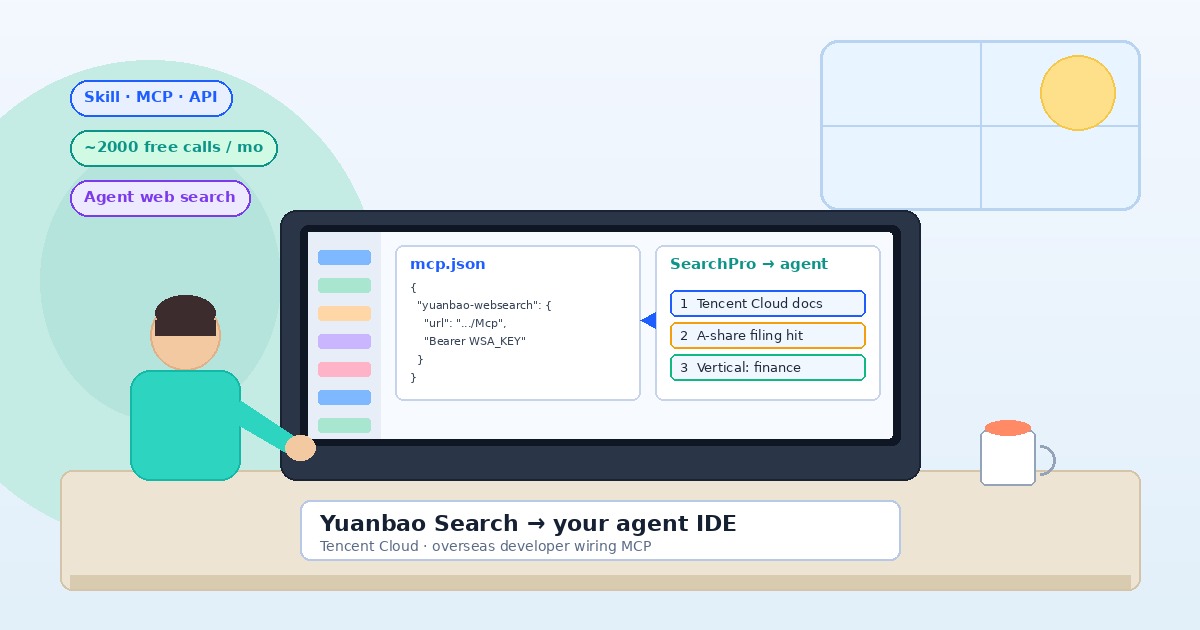
Chinese agent stacks have been quietly relying on Tencent’s internal search for a while. What changed this week is the packaging: the search layer behind WorkBuddy, ima, Tencent FinTech, Tencent Video, and 50+ other internal products is now sold as a developer product — a metered tool API you can drop into an agent instead of scraping the open web yourself.
Company materials describe an index at hundreds-of-billions scale (千亿级), hundreds of millions of daily internal calls, and a mix of public-web crawl plus Tencent’s own content ecosystem (Tencent News, Sogou Baike, Penguin accounts, and similar). Treat those scale numbers as Tencent’s claims from the launch coverage, not as independently audited figures.
What you can actually call
Three access paths are advertised:
- Skill — drop search into agent skill configs where your runtime supports them.
- MCP — streamable HTTP MCP server at
https://api.wsa.cloud.tencent.com/Mcp, auth viaAuthorization: Bearer YOUR_WSA_API_KEY, single tool SearchPro (MCP protocol version noted as 2025-06-18 in the docs). - API — classic Tencent Cloud API on
wsa.tencentcloudapi.com(ActionSearchPro, Version2025-05-08).
SearchPro accepts a required Query (UTF-8, roughly ≤500 CJK/Latin characters) plus optional filters: site scope, result mode (public web / vertical “authoritative” cards / mixed), freshness windows, result count (10–50 on higher tiers), and industry tags such as gov / news / acad / finance. Docs pitch auto-denoised snippets meant to be LLM-token-friendly, site- and time-scoped retrieval, and vertical plugins for weather, equities, FX, and similar live cards.
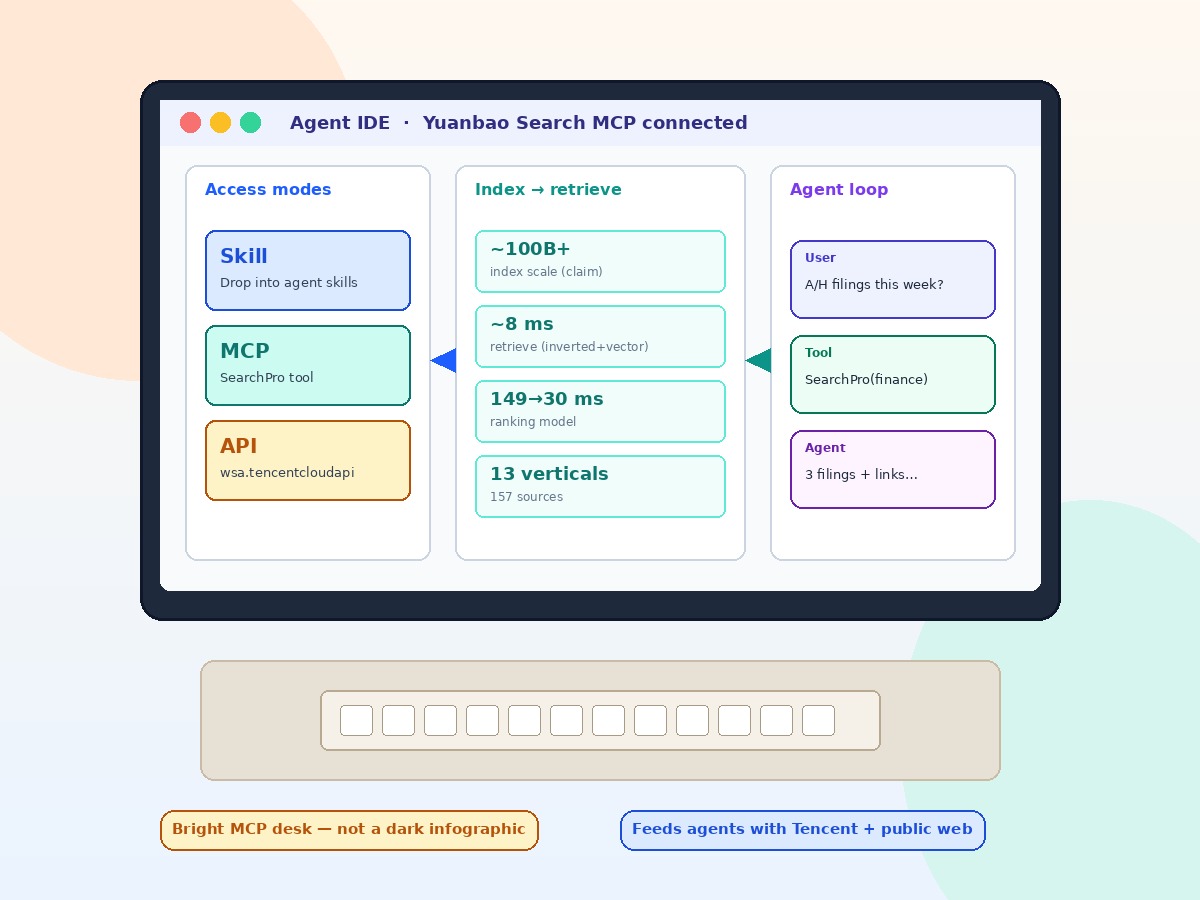
Illustration: Skill / MCP / API as interchangeable access modes, with SearchPro sitting in the agent tool loop — light palette, not a reused dark infographic.
Latency and coverage claims
Launch reporting quotes engineering numbers worth keeping separate from product marketing:
- Fused inverted + vector retrieval averaging about 8 ms at the index layer
- Core ranking-model inference cut from 149 ms → 30 ms
- Yuanbao App end-to-end response shortened by nearly 1 second
- 13 vertical industries and 157 “authoritative” sources; claimed 99%+ coverage of A / H / US / Japan / Korea stock filings
- Minute-level refresh for policy, news, weather, and market quotes
Inside Tencent, examples cited include WorkBuddy pulling first-hand docs and official APIs (fewer tool hops), ima gaining roughly 10% more useful source recall when mixing knowledge bases with the public web, Tencent Video expanding plot/fuzzy-title findability by about 20%, and FinTech standing up a finance search surface in about a week. Those are company case studies, not your SLA.
Yes in principle — if you can open and keep a Tencent Cloud account, enable Yuanbao Search in the console, and mint a WSA API key. Chinese cloud accounts typically require real-name verification; international individuals and companies should confirm signup, billing currency, and whether the free-tier campaign still applies to their account type on the console’s activity page (docs explicitly say free-quota rules follow that page). The index and vertical cards lean China-heavy (Tencent content + China-market filings and domestic verticals), so treat it as a strong China / Greater China retrieval tool that also hits the public web — not as a drop-in global Google replacement. Paid capacity sits behind Lite / Standard / Flagship SKUs (Flagship is enterprise-only); this article does not invent post-free pricing — check the live product page and billing console.
Business-model angle
This is the agent-tooling pattern overseas builders already know from Bing, Brave, SerpAPI, and similar metered search APIs — Tencent’s twist is shipping the same stack its internal agents already burn hundreds of millions of calls on, with MCP as a first-class path. For product teams, the free ~2,000 calls/month is enough to prototype an agent that needs Chinese filings, Tencent-ecosystem pages, or Chinese-language news without standing up a crawler. For anyone past free tier, search becomes another line item next to tokens: buy retrieval as a utility instead of owning the index.
Versions matter. Product docs split Lite / Standard / Flagship by ranking model strength, whether vertical “VR” cards and dynamic summaries appear, how many results you can request, and whether authority grades or attachment deep-links are available. Pick the SKU against the agent job — finance filings and vertical cards need more than Lite’s public-web-only surface.