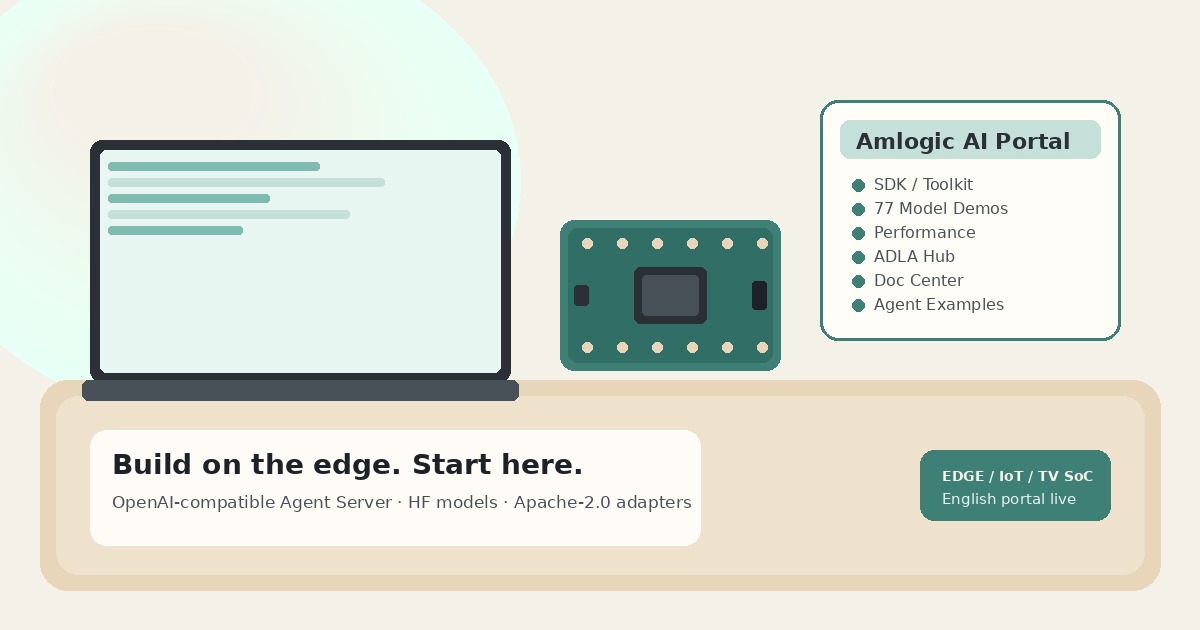
If you already ship TVs, set-top boxes, smart displays, or IoT gateways on Amlogic silicon, the practical change is not a new NPU headline — it is a single English front door. The portal’s tagline is blunt: “Build on the edge. Start here.” Model lists, conversion/runtime toolkits, documentation, and throughput numbers that used to live in FAE threads and internal shares are now linked from one public site, with the GitHub org holding the code adapters.
Six hubs that map a real bring-up path
The homepage surfaces six entry points that roughly match how an edge team actually works:
- SDK / Toolkit — model conversion through native inference; Python and C/C++ paths
- Model Demos — about 77 model entries (NBD notes the filter bar may show 78 resources including a platform build guide)
- Performance — CNN / LLM / VLM throughput, latency, memory, and accuracy tables; data snapshot dated ~Oct 12, 2026
- ADLA Hub — prebuilt ADLA packages mirrored on Hugging Face (
Amlogic-NN/amlnn-adla-models) and ModelScope (Amlogic/amlnn-adla-models) - Doc Center — about 24 docs (quickstart, API, operators, deploy guides)
- Agent Examples — client integration docs plus reference scenario cards
Four homepage counters reinforce the same story: ~77 adapted models, ~24 docs, Python + C/C++ SDK paths, and one OpenAI-compatible Agent Server surface.
Toolkits: prototype in Python, harden in C/C++
NBD’s walkthrough of the SDK page lists six pieces. On the Python side: Amlogic NN Toolkit (convert / quantize / compile / infer), NN Edge Toolkit Lite (board-side CNN prototyping), and LLM Edge Toolkit Lite (streaming, multi-turn, sampling, chat templates). The production path is the C/C++ pair — libnnsdk.so + nnsdk2.h for classic nets, libllmsdk.so + llmsdk.h for LLM streaming via callbacks — targeting Android and Linux.
The headline integration for agent builders is Amlogic Agent Server: an on-device LLM/VLM serving layer that speaks OpenAI-style APIs, with streaming, tool/function calls, ASR endpoints, KV-cache reuse for multi-turn chats, and an experimental edge–cloud routing path when an upstream is configured. The PyPI package amlllm-openai-server and the related GitHub server repo make the “point your LangChain / PicoClaw client at http://<board>:8000/v1” story concrete — for boards that already run Amlogic LLMSDK + ADLA.
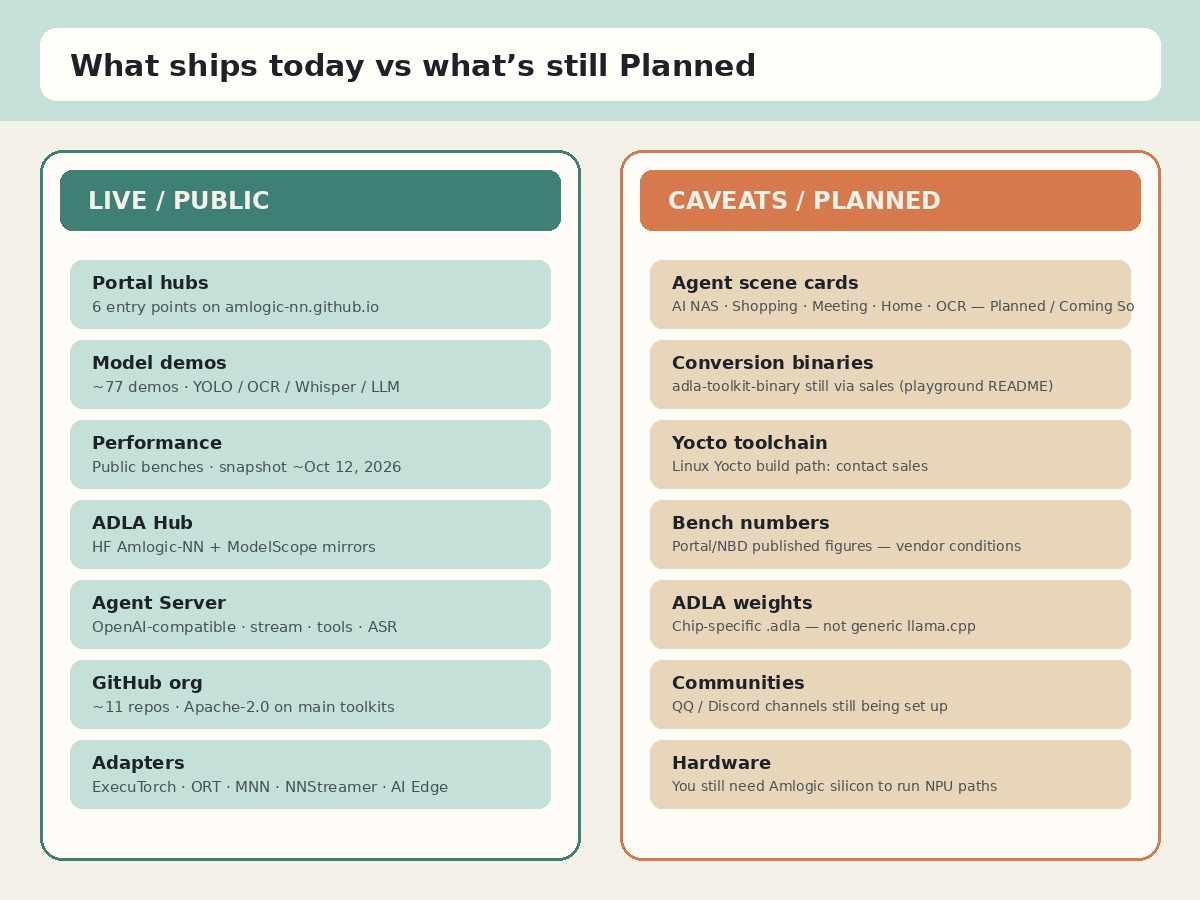
Illustration: what is public today vs Planned/sales-gated. Treat Agent scenario cards and bench FPS/tok/s as labeled claims.
Published benches on A311Y3 — keep the quote marks
The Performance hub publishes multi-platform tables (CSV export is mentioned in press). NBD highlights an A311Y3 Armbian reference board under a W4A16 setup. Figures below are portal/NBD published numbers, not independent lab runs:
- CNN — mobilenet_v2 ~1014.2 FPS; resnet50 ~266.9; yolov8n ~191.1; yolov8s ~83.1; BlazePose keypoints ~328.4; Whisper tiny decoder ~51.6; CLIP ViT-Base ~73.0
- LLM/VLM (Seq64 / Context320 / Output256 per NBD) — Gemma3-270M ~86.4 tok/s; MiniCPM4-0.5B ~72.9; Qwen2-0.5B ~63.6; DeepSeek-R1-1.5B ~22.7; Qwen-VL2-2B ~22.9; Qwen3-4B ~9.0 tok/s; Llama2-7B ~5.4; MiniCPM-V 2.6-8B ~2.1
- Accuracy snapshots — ResNet50 Top-1 ~75.9% at W8A16 (vs ~72.4% W8A8); MMLU 5-shot (500 samples) Qwen3-4B-Thinking ~0.814, Instruct ~0.730 — company/portal figures
Quantization support differs by silicon generation. Newer platforms A311Y3, C305X2, and A123X are listed for W8A16 / W16A16; A311D2 and S905X5 for W8A8. Always read the snapshot date and board/OS notes before you budget a product SKU around a single FPS cell.
ADLA Hub and the model zoo
Instead of only shipping conversion scripts, Amlogic mirrors ready ADLA artifacts. Hugging Face’s Amlogic-NN/amlnn-adla-models README describes LLM/VLM/ASR packages meant to be pulled by the Agent Server bootstrap (list / download), with Qwen2.5 / Qwen3 / VL / Whisper-class entries and tool-calling flags. These are Amlogic ADLA build artifacts — they are not drop-in weights for generic transformers or llama.cpp; they need Amlogic runtime on real silicon.
The companion amlnn-model-playground repo packages demos across classification, detection (YOLOv5–v11 and friends), pose, segmentation, OCR, audio, and LLM/VLM, with conversion + Python / OpenAI API / C workflows.
Mostly yes for reading, cloning, and prototyping — with two hard caveats. The portal, GitHub org, Hugging Face hub, and PyPI Agent Server package are public and English-first. You still need Amlogic hardware for NPU paths. The playground README states that full model-conversion binaries (adla-toolkit-binary-x.x.x.x) currently require contacting an Amlogic sales representative; Yocto toolchains are similarly sales-gated. Prebuilt ADLA packages and on-board lite runtimes reduce that friction for common models, but custom conversion is not fully self-serve yet.
Agents: OpenAI wire today, scenario cards later
Integration docs already describe wiring Agent Server into PicoClaw, DeepSeek Harness, and LangChain over the OpenAI-compatible loop. Five reference scenarios appear on the portal — AI NAS (media/face search, summaries), AI shopping, meeting notes (ASR + diarization + summary), home voice assistant (ASR / dialogue / TTS), and OCR translation. NBD and the portal itself label these as Planned Example / Coming Soon. They are roadmap cards, not shipping one-click products. The portal’s own publish notes also warn that reference scenario cards describe possible workflows and do not imply released projects.
Eleven public repos and third-party runtimes
GitHub lists about 11 public repositories under Amlogic-NN. Headline ones include amlnn-toolkit, amlnn-model-playground, amlnn-multibackend (CPU/GPU paths for SoCs without NPU), amlnn-third-party-runtime (NNStreamer, ExecuTorch, ONNX Runtime, MNN), aml-onnxruntime, and Google AI Edge–facing adapters (NNAPI / LiteRT / MediaPipe). Press and org materials describe the main toolkits as Apache-2.0 — verify LICENSE files per repo before you redistribute.
Honest caveats
- Agent scene cards — Planned / Coming Soon; integration docs exist, full scenario packs do not claim GA.
- Conversion binaries — playground README: contact sales for
adla-toolkit-binaryin the short term; Yocto similarly sales-gated. - Bench numbers — portal/NBD figures under stated board/quant/seq settings; not third-party audits.
- ADLA format — chip-specific artifacts; not portable to stock llama.cpp / transformers.
- Community channels — QQ / Discord still marked as being created on the portal.
- Hardware — public software does not replace needing Amlogic silicon for NPU inference.
Bottom line for overseas engineers already on Amlogic (or evaluating A311Y3 / S905X5-class parts): you can open an English portal, pull HF ADLA packages, clone Apache-licensed adapters, and point an OpenAI-compatible client at a board-local Agent Server without starting an email chain for the first prototype. Budget time for sales if you need the full conversion binary or Yocto toolchain, keep every FPS and tok/s figure in the vendor column, and treat the five Agent scenario cards as roadmap until the Planned labels disappear.