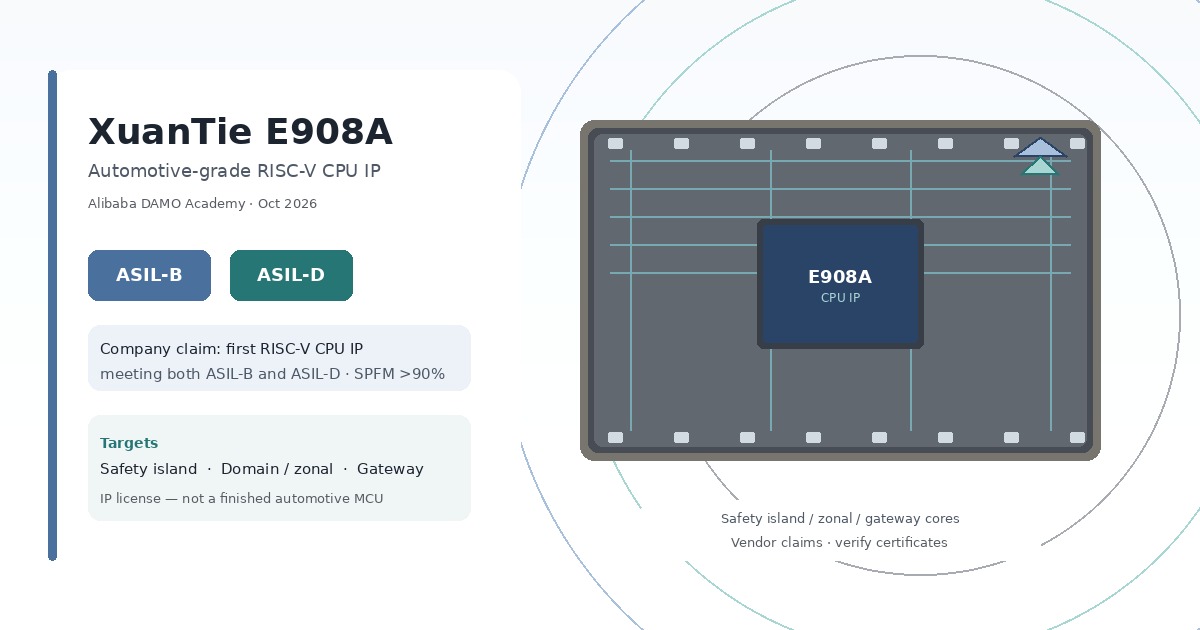
If you design automotive SoCs, MCUs, or zonal controllers outside China, the usable takeaway is narrow and practical: E908A is something a silicon vendor can license, then integrate into a safety island, domain/zonal controller, or in-vehicle gateway. You will not buy an E908A chip from Alibaba and drop it into a car. DAMO sells the design; chip companies tape out; OEMs and Tier-1s qualify volume silicon years later.
What DAMO actually shipped
Chinese coverage from Yicai, IT之家, AutoCN, and a deeper Vehicle column on EET-China converge on the same product frame:
- Product type: XuanTie (玄铁) E908A — automotive-enhanced RISC-V CPU IP.
- Safety claim: first RISC-V CPU IP said to meet both ASIL-B and ASIL-D; SPFM >90% (DAMO).
- Targets: safety island, domain/zonal controllers, in-vehicle gateway; real-time control. Chinese trade press also mentions support for CAN-FD and TSN-class in-vehicle networking needs.
- Performance vs peers: roughly ~20% ahead of contemporary rivals — again a vendor / trade-press figure, not an independent lab result.
- Shipments backdrop: XuanTie cumulative shipments >6 billion cores (company), mostly outside automotive so far.
DAMO describes a self-developed STL (software test library) soft/hardware co-design path for functional safety. Treat “Compliant” wording in Chinese press as marketing until third-party certificates are published for a specific silicon implementation.
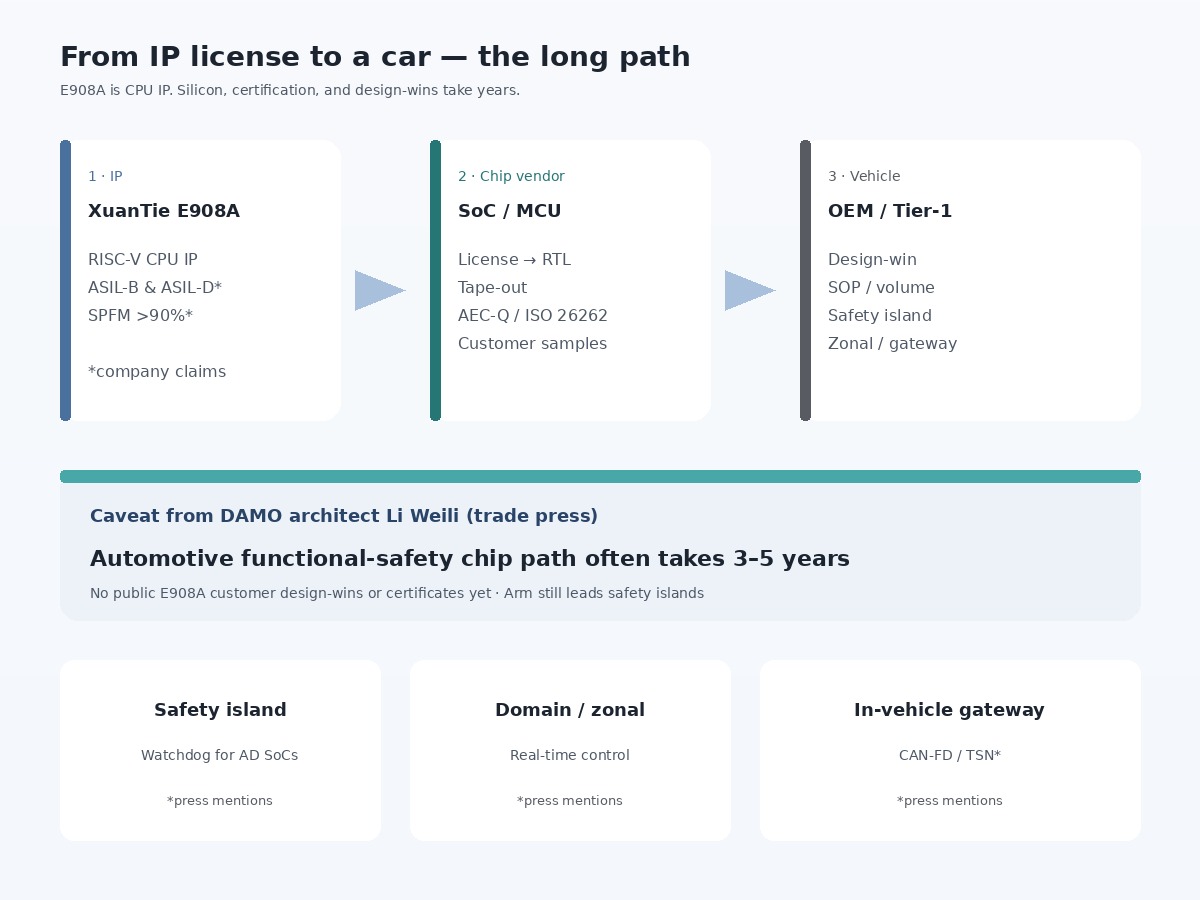
Illustration: IP → chip vendor → car. The 3–5 year span is how DAMO architect Li Weili has described the automotive functional-safety chip path in trade press — not a promise for E908A specifically.
Where it would sit in a vehicle
E908A is aimed at control and supervision, not the big AD perception GPU/NPU. That focus matches where EE architecture is adding cores:
- Safety island — a small, separately clocked/powered watchdog next to a large AD SoC. When the main compute misbehaves, the island forces degradation or stop. This seat usually wants ASIL-D-class assurance and has long been Arm real-time territory (with selective RISC-V already showing up in products such as Mobileye EyeQ Ultra and parts of Horizon Journey 6, per trade press).
- Domain / zonal controllers — consolidating body, chassis, and actuator control as vehicles move toward central compute + zonal nodes.
- In-vehicle gateway — bridging domains; CAN-FD / TSN show up in Chinese coverage as relevant interfaces for these cores.
Indirectly. Chip designers and fabless MCU/SoC vendors can evaluate licensing the IP from DAMO’s XuanTie group and putting it on a roadmap. Automakers and Tier-1s should watch for customer SoCs that name E908A (or a derivative) in a safety island or zonal MCU — then run the usual ISO 26262 / AEC qualification on that silicon. There is no public E908A end-customer design-win list or certificate packet as of this writing. Arm remains the default for many safety islands; domestic peers such as Nuclei (芯来) with Dongfeng and C*Core / 国芯 already look further along on some volume paths, according to Chinese industry reporting.
Roadmap: C950A for AD / embodied AI — sparse public detail
Alongside E908A, DAMO sketched a longer automotive / embodied-AI line. The headline next step is C950A, aimed at AD compute and embodied AI, with a target of roughly 5× the performance of existing RISC-V automotive products (company / summit claim). Summit materials covered in Yicai and IT之家 do not publicly pin process node, frequency, ASIL grade, or a firm timeline for C950A — call that out when comparing to Arm AE-class application cores already in production programs.
The base server core C950 (announced March 2026) is the technical backdrop DAMO leans on: up to 3.2 GHz; SPECint2006 single-core said to be the first RISC-V past 70 (company); at the Shenzhen summit, a Qwen3.8-Flash-Next inference figure of about 43 tokens/s was cited — again a vendor number. Press also names intermediate roadmap labels such as C925A / C930A in some Chinese reports; treat the full ladder as directional until datasheets land.
Competitive context, without the hype
Infineon announced a RISC-V automotive MCU family earlier (folded under the AURIX brand in 2025 reporting), but Chinese industry sources quote volume closer to 2028 — so “announced” and “in SOP cars” remain different clocks. European consortia such as Quintauris are still building reference platforms. That leaves a multi-year window where Chinese RISC-V auto IP and MCUs can prove themselves — if software (AUTOSAR stacks, certified toolchains) and OEM willingness keep up. CPU IP license cost is rarely the deciding line item; supply control, custom instructions, and area/power are.
Honest caveats
- IP ≠ silicon in a car. E908A changes vendor selection tables first; SOP vehicles come later.
- 3–5 years is how DAMO architect Li Weili has characterized the typical automotive functional-safety chip path in trade press (EET-China / Vehicle) — a useful planning heuristic, not an E908A schedule.
- No public customer design-wins or third-party certificates for E908A yet.
- ASIL-B + ASIL-D / SPFM >90% / ~20% performance are company or trade-press claims until independent evidence is published against a specific chip.
- Arm still dominates many safety-island sockets; RISC-V is gaining footholds, not replacing the field overnight.
- Domestic peers (Nuclei/Dongfeng, 国芯 and others) already have clearer volume stories in some cases — XuanTie’s card is scale (>6B cumulative cores) and ecosystem, not first-to-SOP in auto.
- C950A “~5×” lacks public process, frequency, and timeline in the core summit briefings cited here.
Bottom line for overseas chip designers and Tier-1 architects: E908A is a credible signal that a large Chinese IP house wants the safety-island and zonal seat with a dual ASIL-B/ASIL-D story. Put it on the watch list for 2027–2029 SoC RFQs; do not treat the Oct 19 announcement as a drop-in Arm replacement shipping in next year’s platforms. License if you are building silicon; otherwise wait for named customer chips, certificates, and AUTOSAR support — and keep Arm (and any Infineon RISC-V timeline) on the same comparison sheet.