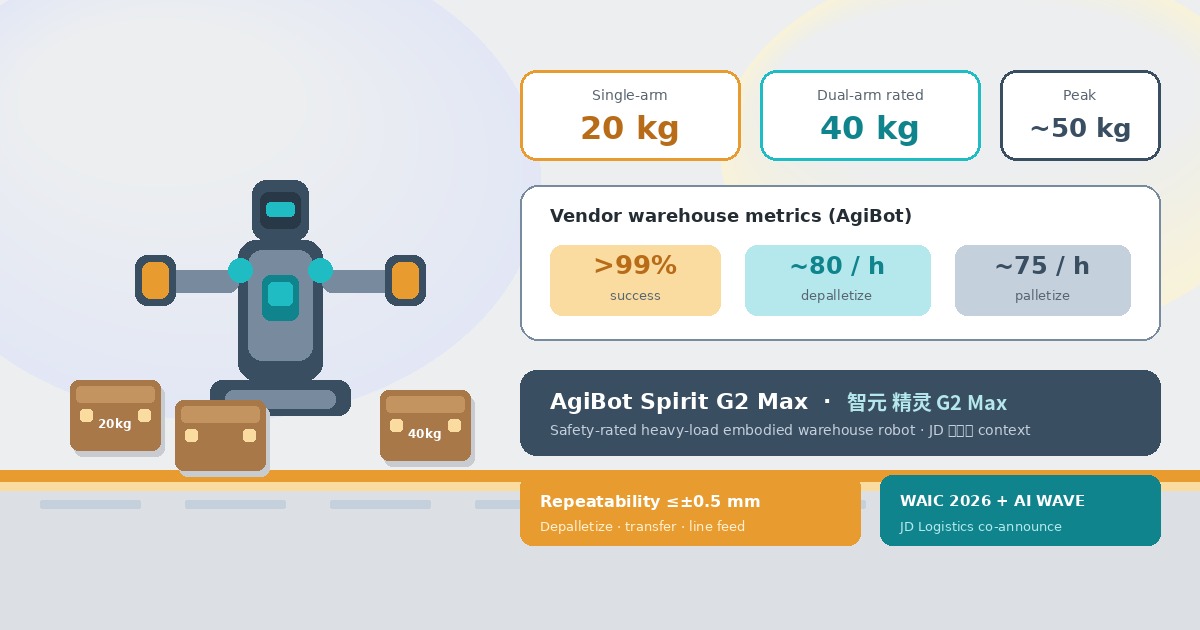
AgiBot positioned G2 Max as an 安规级 (safety-rated) heavy-load embodied platform for industrial scenes that still break fixed automation: pulling standard totes off pallets, moving them across a bay, and feeding a line — work that still burns human backs on inbound shifts. Chinese coverage on Oct 26 (IT之家; 证券时报 via 第一财经 / AI WAVE) quotes the arm ratings as single-arm 20 kg, dual-arm rated 40 kg, dual-arm peak about 50 kg, with arm repeatability ≤±0.5 mm.
What the vendor says it does on the floor
AgiBot says G2 Max is already running on multiple production lines. In e-commerce warehouse scenes, the company discloses >99% task success, about 80 boxes/hour depalletizing, and about 75 boxes/hour palletizing. Treat those as vendor metrics until third-party or customer-published numbers show up — useful as an order-of-magnitude pitch, not as a guaranteed SLA for your SKU mix.
Beyond classic depalletize / transfer / line-feed, Oct 26 brief coverage also lists unpacking and feeding, empty-tote recovery, and warehouse inbound. One cited factory case: at 沪光股份’s Qiyuan T1 robot manufacturing line, G2 Max is described as matching a ~2.5 minutes per robot takt to help with “robots building robots.” That is a vendor/factory narrative, not an independent time-study.
Oct 26 press: single-arm 20 kg · dual-arm rated 40 kg · dual-arm peak ~50 kg · arm repeatability ≤±0.5 mm. Earlier WAIC-era writeups floated slightly different mid-load figures (e.g. ~18/38 kg in some July coverage) — prefer the Oct 26 formal launch numbers when you quote the product.
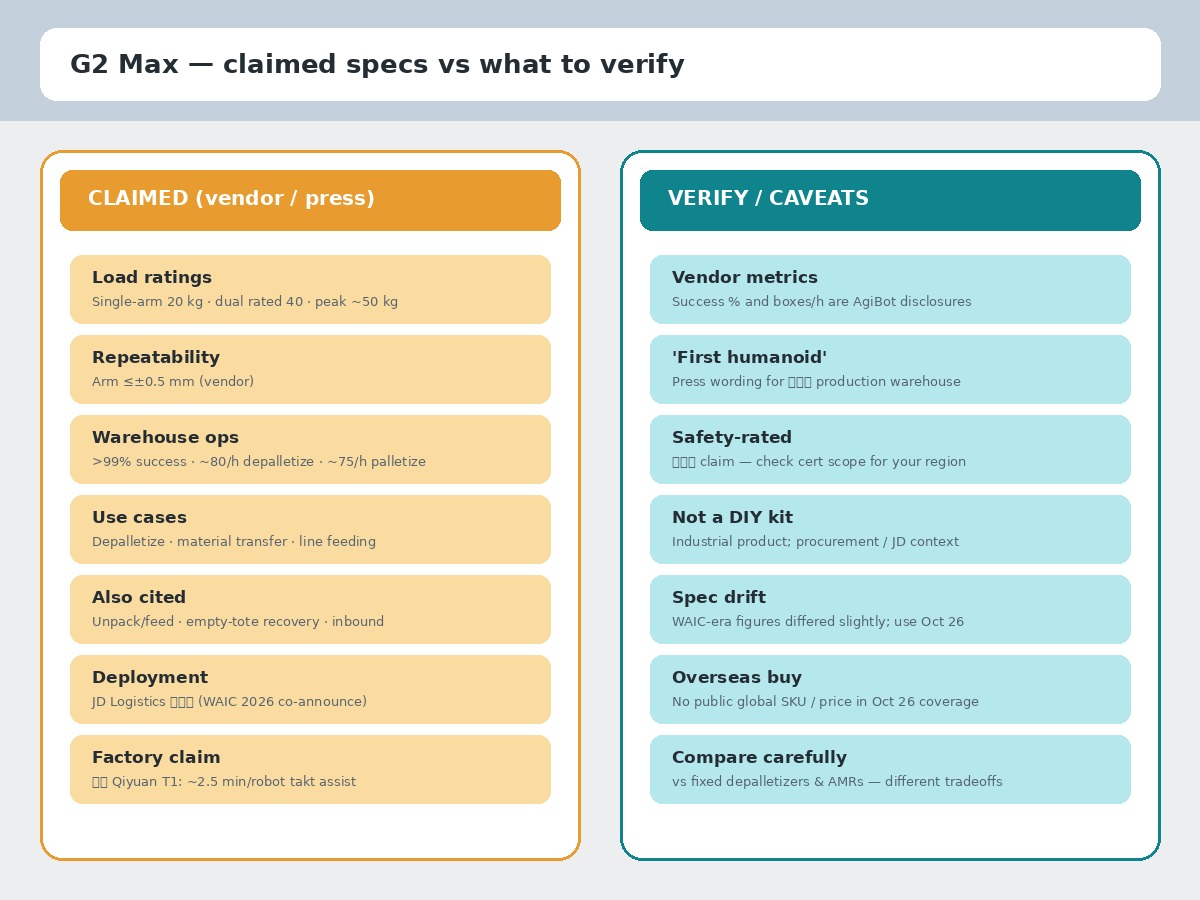
Claimed vs verify: concrete load and repeatability figures sit next to vendor warehouse throughput and “first humanoid in production warehouse” press wording.
JD Logistics and the 智狼仓 context
G2 Max is not a brand-new sketch from this week. At WAIC 2026 in July, JD Logistics and AgiBot jointly introduced the same product family and said it would go into JD’s 智狼仓 (Zhilang / “Smart Wolf”) intelligent warehouses. Multiple Chinese outlets — and English writeups such as iGeekPhone — repeated the line that this was the first time a humanoid robot entered real warehouse production operations in that inbound context. That is press/partner wording: JD’s outbound “goods-to-person” stack was already heavily robotized; the pitch is closing the remaining inbound bend-lift-stack gap with a humanoid form factor that can run continuous shifts without night-shift rotation.
JD’s public comments around WAIC framed the win as lower employee physical load on inbound (they already claimed large step-count reductions from outbound robots) rather than as a fully lights-out warehouse. If you evaluate G2 Max against a European or US DC, the interesting comparison is not “humanoid vs human” in the abstract — it is humanoid flexible inbound vs a fixed depalletizer + AMR tote fleet, on cost, changeover time, and aisle geometry.
Can overseas teams buy or use it?
Not as a catalog DIY or a public global SKU — at least not from Oct 26 coverage. This is an industrial embodied robot sold into Chinese warehouse and factory deployments, with JD Logistics as a marquee co-announce partner. Overseas logistics and robotics buyers should treat today’s launch as:
- A competitive benchmark — 20/40/~50 kg dual-arm ratings plus ≤±0.5 mm repeatability are concrete enough to put next to Figure, Agility, Apptronik, and Chinese peers when RFPs ask for tote-scale humanoids.
- A deployment signal — JD 智狼仓 + multi-line CPG / e-commerce / food validation claims matter more than booth demos, even when metrics are still vendor-side.
- Not a plug-and-play import — safety rating (安规级) scope, CE/UL equivalents, spare parts, and integration SDKs are not spelled out in the Oct 26 consumer-tech writeups. Procurement still goes through AgiBot / partner channels; AgiBot’s public product pages currently emphasize the broader Spirit G2 line more than a standalone G2 Max English datasheet.
What actually changes
Most warehouse robotics still splits into AMRs that move shelves/totes and fixed cells that depalletize at high rate but hate SKU churn. A safety-rated dual-arm humanoid that claims tote-scale loads and sub-millimeter repeatability is AgiBot’s bet that one platform can cover the messy middle — inbound depalletize, short transfers, and line feed — without rebuilding the cell every time the carton changes. Whether 80/75 boxes per hour is competitive with a dedicated depalletizer depends entirely on your mix; where G2 Max is meant to win is flexibility and continuous operation in human-designed aisles, not peak cartons on a single SKU.
Honest caveats
- Warehouse success % and boxes/h are vendor disclosures — AgiBot via IT之家 Oct 26; not independent audits in the coverage we saw.
- “First humanoid in real warehouse production” — repeated JD/AgiBot/press line from WAIC; verify what “production” means for your comparison set.
- Safety-rated (安规级) — Chinese press label; check which standards and for which countries before you assume CE/ISO collaborative compliance.
- Spec drift across articles — prefer Oct 26 20/40/~50 kg over earlier WAIC mid-load figures when quoting.
- No public overseas price or SKU in Oct 26 consumer coverage — industrial sales motion.
- Factory “robots building robots” takt story is a cited deployment narrative, not a general performance guarantee.
Bottom line for overseas warehouse and robotics teams: Spirit G2 Max is one of the clearer Chinese heavy-load humanoid pitches this year — concrete arm ratings, a JD Logistics warehouse partner story dating to WAIC 2026, and vendor throughput numbers you can put on a slide with a big asterisk. Use it as a competitive and deployment signal; do not treat the boxes/hour claims as your RFP answer without a site pilot.