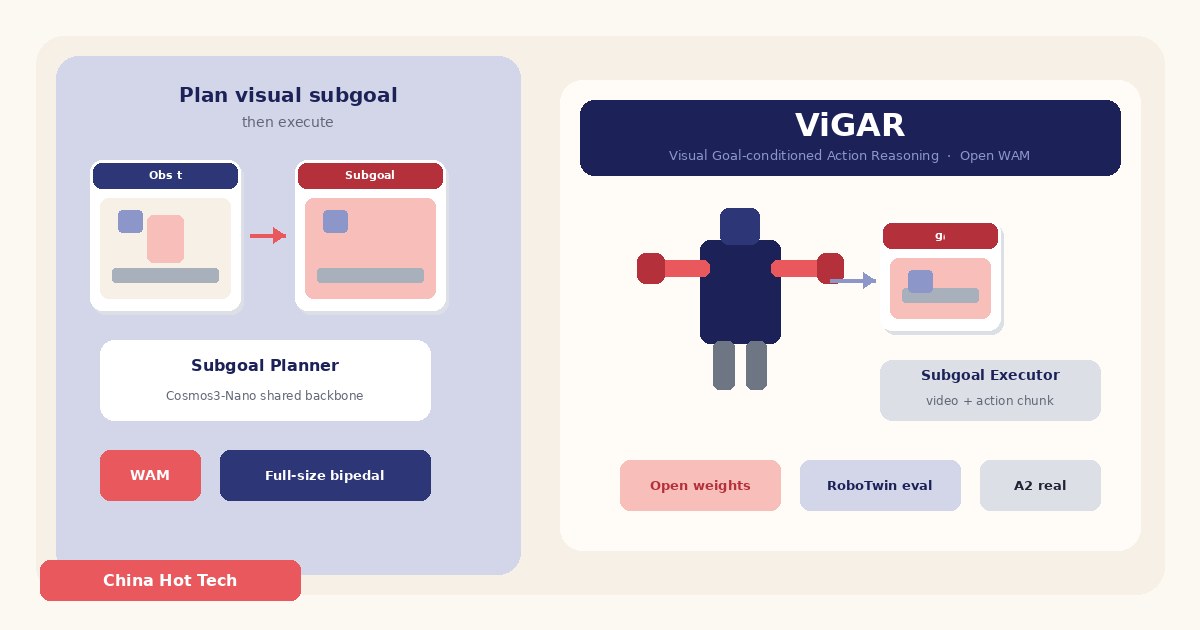
Most world-action models (WAMs) learn to predict a short visual future and an action chunk in one go. That works for short skills; it gets brittle when a job is really a chain of subtasks — stamp a letter and hand it over, clear a desk into a bin, pull steamed buns from both tiers of a steamer. ViGAR, announced around 22 Oct 2026, splits the problem the other way: first predict what the scene should look like after the next subtask, then generate the video-and-action trajectory that gets there. The team validated that loop on AgiBot A2, a full-size bipedal humanoid with two 7-DoF arms, wrist cameras, and a front camera.
What it is
Architecturally ViGAR is two modules that share a pretrained world-model backbone (Cosmos3-Nano reasoner–generator):
- Subgoal planner — given the current multi-view observation and a language instruction (optionally a global goal image), predict the next visual subgoal image.
- Subgoal executor — conditioned on that predicted subgoal, jointly generate future frames and an action chunk.
The paper frames this as “long-term future selection, then short-term future realization,” against the common observe→act VLA path and against WAMs that bolt an action head onto a video generator without an explicit subtask interface. Training tricks called out in the report include a subgoal look-ahead rule (so the planner does not regenerate a completed subgoal at stage boundaries) and end-effector ROI weighting on the planning loss. Ablations in the paper say dropping both costs about twelve percentage points on RoboTwin average success.
Yes, for research. The technical report is on arXiv (2610.02368), code is on GitHub DAGroup-PKU/ViGAR, and weights plus RoboTwin eval / training assets are listed on Hugging Face and the project page. The ~900-hour A2 mid-training corpus is described as planned for opening, not necessarily shipped with the first drop — check the download docs before assuming the full real-robot dataset is public.
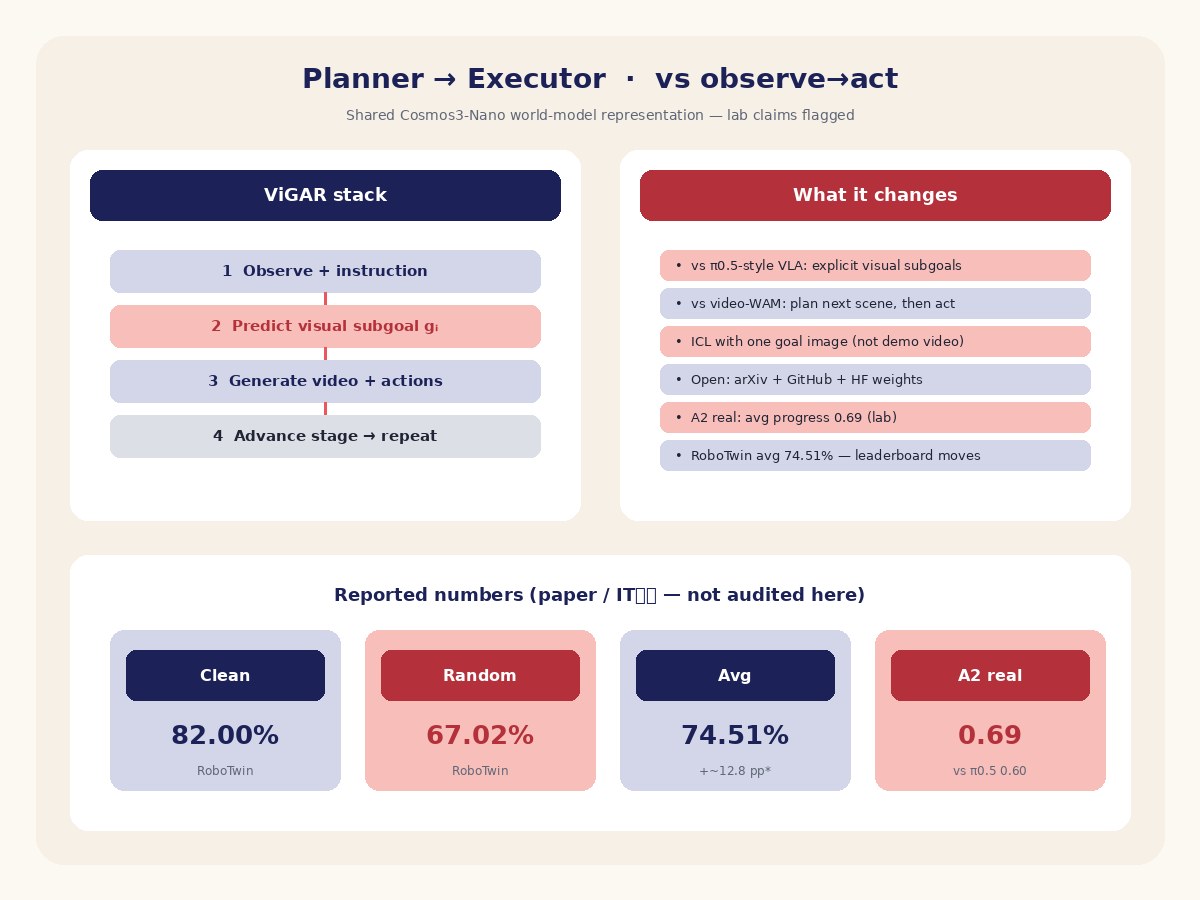
Planner → executor vs observe→act. Asterisked benchmark deltas and real-robot progress scores are from the paper / Chinese press; the live RoboTwin leaderboard moves.
Simulation: RoboTwin Clean2Random
On RoboTwin 2.0’s Clean2Random protocol (train on Clean demos only; test on Clean and heavily randomized scenes), the paper reports:
- Clean 82.00%, Random 67.02%, average 74.51%
- About +12.8 percentage points over the strongest baseline at publication (IT之家 and the project page cite +12.81 pp; the arXiv abstract rounds the same gap as +12.86 pp — treat as one lab-reported delta, not two independent audits)
- Chinese coverage says ViGAR briefly sat at #1 on publish and was about #3 on the live total board as of mid/late Oct 2026 — leaderboards reshuffle; do not treat rank as fixed
RoboTwin is a hard generalization stress test: the same Clean demonstration set, then clutter, lighting, background, and table-height randomization across dozens of bimanual tasks. The paper’s own controlled baseline — Cosmos3-Nano post-trained on the same Clean demos without subgoal guidance — lands much lower under Random, which is the clearest internal evidence that the visual-subgoal split is doing work beyond “just use a bigger world model.”
Real robot: AgiBot A2
On A2, the team mid-trained on roughly 900 hours of same-embodiment teleop covering 752 tasks, 200+ objects, and 10+ backgrounds, then post-trained on task demos. Five long-horizon compositional tasks (3–5 sequential stages each, 20 trials apiece) are scored by task progress — fraction of ordered stages completed — rather than only full-task success. Reported averages:
- ViGAR 0.69
- π0.5 0.60
- Cosmos3-Nano-Policy (same data recipe, no subgoal) 0.54
Tasks in the writeups include stacking cups, sorting colored bowls, stamp-and-hand-over, desk tidy-up, and pulling steamed buns from a two-tier steamer. Those are lab-reported progress scores on a specific platform and data mix — useful as a directional signal, not a third-party bake-off.
In-context steering with one goal image
Unlike Zero-WAM / GEN-1.5-style systems that condition on a human demo video, ViGAR’s planner can take a single global goal image as context. Holding scene and language fixed, a different terminal image is supposed to induce a different subtask decomposition without weight updates. Real-robot ICL probes in the paper (fruit arrangement; desktop item storage) report higher in-domain progress than out-of-distribution goals — expected, and a reminder that “one image steers the policy” is a research capability with a clear domain gap, not a finished product API.
What it changes for embodied stacks
Relative to π0.5-style VLAs, ViGAR makes the intermediate scene state an explicit decision variable instead of hoping language subgoals or latent features carry the plan. Relative to “video WAM + action head” routes, it refuses to black-box the subtask boundary: the planner must paint the next world state before the executor moves. For teams already living in RoboTwin / dual-arm manipulation land, the practical change is simpler — there is now an open hierarchical WAM checkpoint, eval harness, and paper you can reproduce against, on a full-size bipedal embodiment rather than only tabletop arms.
Roadmap notes (vendor / lab)
IT之家 and AgiBot-facing coverage mention adapting ViGAR toward the A3 platform, opening the ~900-hour A2 corpus, and pointing non-algorithm operators at AgiBot’s HERA skill platform for collect–train–deploy workflows. Treat those as stated intentions from Chinese press and partner messaging until the corresponding repos and datasets land.
Honest caveats
- Lab / press numbers — RoboTwin percentages, the ~12.8 pp gap, A2 progress 0.69 / 0.60 / 0.54, and ICL in-domain vs OOD scores come from the paper and IT之家; not independently re-run here.
- Leaderboard moves — “was #1, now ~#3” is a snapshot claim; RoboTwin’s public board updates continuously.
- Embodiment lock-in — real-robot results are on AgiBot A2 with a large same-platform teleop mid-train; transferring to another humanoid is an open research problem, not a promised drop-in.
- Dataset openness — code/weights/RoboTwin assets are the clear public path today; the full ~900h A2 dump is described as forthcoming.
- Different from yesterday’s product post — this is a research WAM release, not the Spirit G2 Max warehouse hardware story.
Bottom line: ViGAR is one of the more complete open WAM packages aimed at full-size bipedal dual-arm work — hierarchical visual subgoals, shared Cosmos3-Nano backbone, RoboTwin numbers that look strong under randomization, and real A2 long-horizon probes. Overseas labs can start from arXiv + GitHub + Hugging Face today; treat ranks, absolute progress scores, and future data dumps with the usual embodied-AI skepticism.