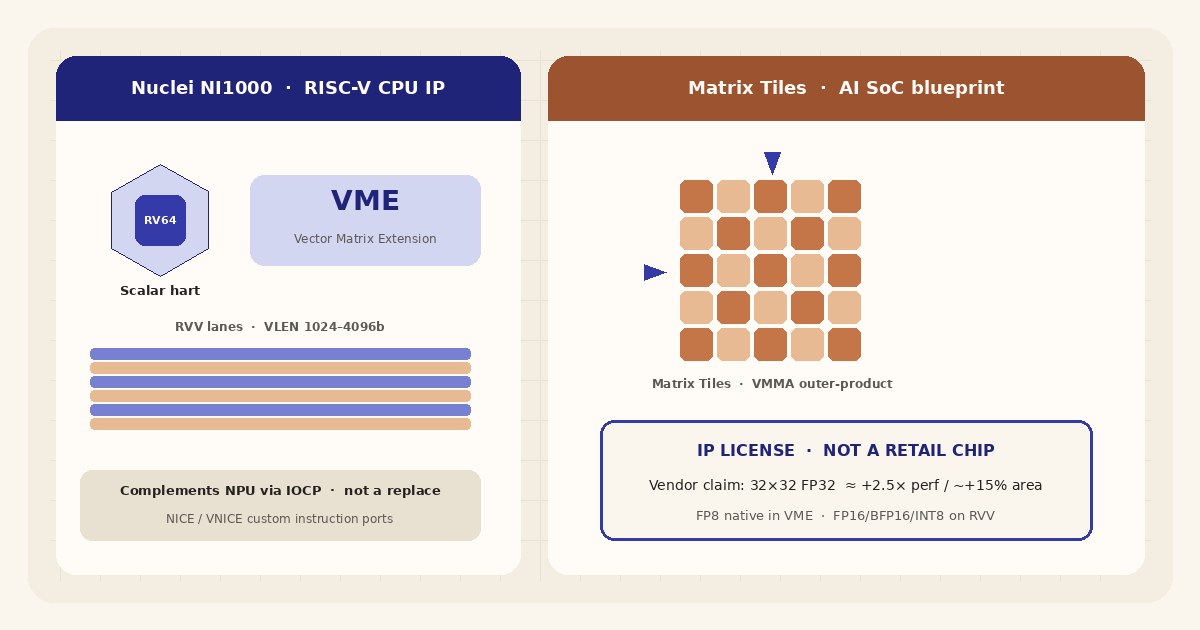
RISC-V SoC teams chasing on-die AI are stuck in a familiar bind: a scalar CPU is too weak for GEMM-heavy kernels, a full NPU is expensive to integrate and schedule around for every residual op, and the emerging matrix-extension zoo (IME, AME, VME) is still being argued in standards rooms. NI1000 is Nuclei’s bet that a mid-cost path — reuse RVV registers and ALUs, add a few Matrix Tile banks, ship native matrix opcodes including FP8 — is what AI chip companies actually want for the “general parallel compute” core next to their accelerator.
What NI1000 is
NI1000 sits in Nuclei’s new NI series, a product line aimed at AI applications and configurable as 900- or 1000-class cores. The headline configuration for NI1000 is a three-layer stack on one hart:
- RV64 scalar — control, ISA compatibility with the standard RISC-V software stack.
- Wide native RVV — vector length configurable at 1024 / 2048 / 4096 bits (NI series also mentions 512b as a lower option). Per-core VPU width can differ inside a cluster. RVV carries FP16 / BFP16 / INT8 for general AI ops; a Vector-NICE port lets licensees bolt on custom vector opcodes.
- VME matrix extension — same-core, tightly coupled to CPU/RVV. Source operands reuse the RVV register file; compute can reuse RVV ALUs; results land in dedicated Matrix Tiles (Nuclei describes four independent tile banks for ping-pong throughput). New native matrix instructions include an outer-product style VMMA path, plus native FP8 in the VME datapath.
Nuclei is explicit that the NI series is not a substitute for NPU or GPU IP. The intended relationship is complementary: an IO Coherent Port (IOCP) keeps cache coherence with an on-die NPU so you move less data; NICE / VNICE (Nuclei’s scalar and vector custom-instruction interfaces) can also tight-couple user logic or talk to the accelerator. Multi-level caches (L1 I/D plus cluster shared cache) and a vector local-memory port (VLM) round out the bandwidth story in the vendor brief.
No — this is licensable CPU IP, not a Digi-Key part or a board you flash next week. Overseas path is the usual IP sales conversation: Nuclei lists contacts in Shanghai, Wuhan, Beijing, and Grenoble (France), plus international email on the announcement page. Expect evaluation kits, RTL/config deliverables, and software bring-up to be gated by an NDA and a license, not a storefront SKU.
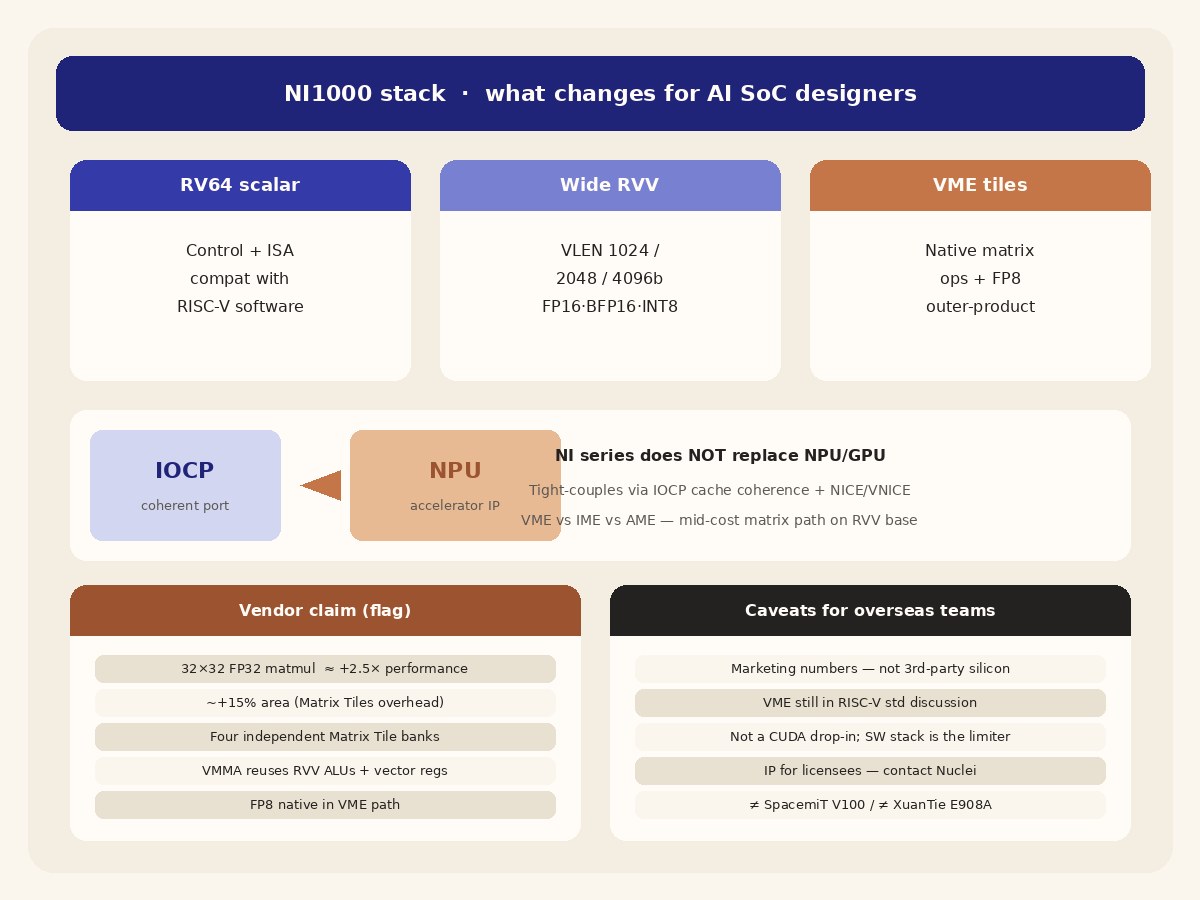
Scalar + wide RVV + VME tiles beside an NPU over IOCP. Asterisked +2.5× / +15% area figures are Nuclei’s own 32×32 FP32 example — not third-party silicon benches.
VME in the matrix-extension landscape
RISC-V’s matrix story is still fluid. Broadly, the community has been discussing denser options that look more like a dedicated matrix engine (AME-style independent matrix register files and accelerators) versus lighter approaches that hang matrix ops off the existing vector extension (IME / VME family). Nuclei’s framing — useful as positioning, not as a standards verdict — is that VME sits in the middle: more matrix accumulation hardware than a pure software-on-RVV path, less area than a full independent matrix subsystem, and software-base reuse because it builds on RVV. The RISC-V Vector-Matrix Extension workstream itself is still in discussion (see the public VME PoW wiki); shipping IP with a VME-shaped feature set does not freeze a ratified ISA forever.
That distinction matters for program managers comparing Chinese IP houses. We have already covered SpacemiT V100 (a server-class SoC) and XuanTie E908A (automotive-safety oriented IP). NI1000 is a different animal: an AI-oriented general compute core IP whose selling point is matrix tiles bolted onto a fat vector unit, aimed at AI SoC houses that already plan an NPU and need a coherent, programmable neighbor.
Headline numbers (vendor)
Nuclei’s worked example for VME is a 32×32 FP32 matrix multiply: they claim about 2.5× matmul performance for roughly +15% area, with the area delta attributed mainly to the Matrix Tiles. Other vendor points that show up in the announcement and Chinese republishers:
- VME sources from RVV vector registers; VMMA outer-products accumulate into N×N tiles; multiple tiles for parallel ping-pong.
- FP8 native on the VME path; FP16 / BFP16 / INT8 emphasized on RVV.
- NICE (scalar) and VNICE (vector) for single-cycle, multi-cycle, or pipelined custom ops, including coherent access into core memory resources.
None of those are independent silicon benches. Until a licensee publishes silicon numbers under a known process node and toolchain, treat them as marketing envelopes for sales conversations.
What actually changes if the IP lands in SoCs
For overseas SoC architects evaluating RISC-V matrix options, NI1000 changes the shopping list more than the software stack overnight. You get a concrete Chinese IP SKU that argues for VME-shaped matrix acceleration without forcing a full AME-style subsystem, with an explicit coherent NPU attachment story. That is relevant if you are sizing die area for “CPU + fat vector + light matrix + NPU” rather than “CPU + giant NPU and hope the CPU never sees a GEMM.”
It does not give you a CUDA migration path. Toolchains, kernels, and model runtimes for RVV+VME will decide whether licensees can actually move workload off the NPU for awkward shapes and fusion leftovers. Software maturity — compilers, libraries, and framework kernels — remains the real limiter for teams outside China, regardless of how tidy the Matrix Tile diagram looks.
Honest caveats
- Vendor marketing numbers — +2.5× / ~+15% area on 32×32 FP32 is Nuclei’s example, not a third-party remeasure on silicon.
- Standards still move — VME is in RISC-V standardization discussion; Nuclei shipping VME-capable IP does not mean a forever-frozen ratified ISA.
- Not a CUDA drop-in — expect to invest in RVV/VME software; that is the overseas risk, not the RTL brochure.
- IP, not a retail chip — contact Nuclei (Shanghai / Wuhan / Beijing / Grenoble); do not plan a BOM around a catalog part number.
- Distinct from prior coverage — not SpacemiT V100 (server SoC) and not XuanTie E908A (auto-safety IP).
Bottom line: NI1000 is a clear Chinese IP pitch for AI SoCs that want RISC-V general compute with matrix tiles next to an NPU. Overseas architects should read it as a VME-vs-IME-vs-AME data point and a licensee conversation — and stay skeptical of the matmul multipliers until silicon and software show up together.