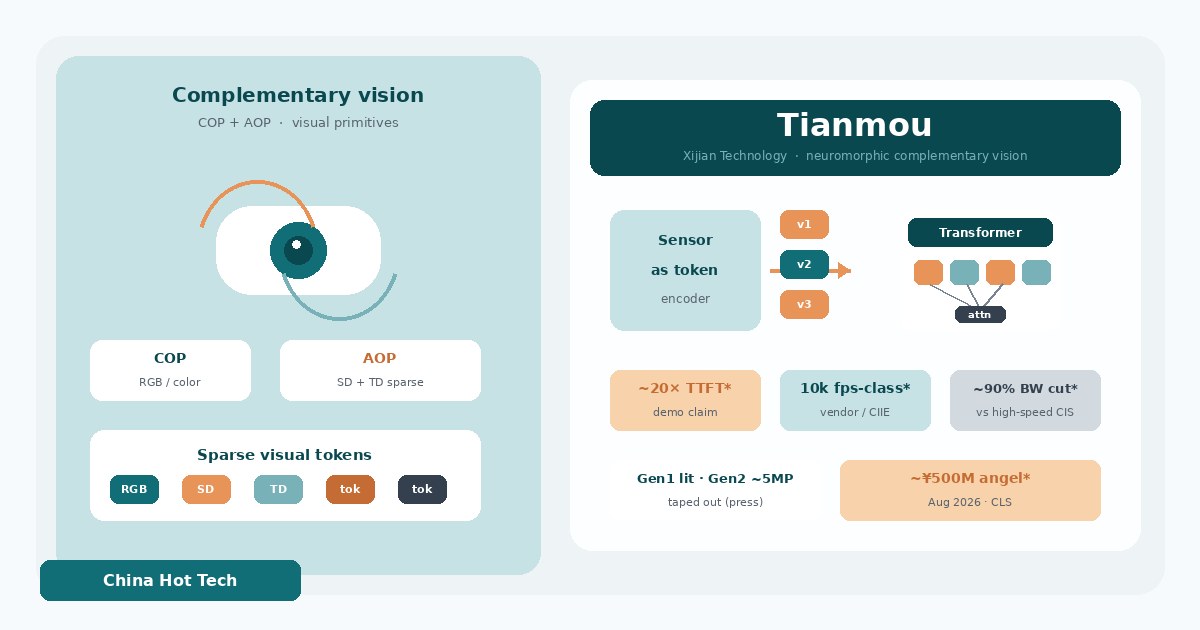
Robotics, embodied, AV, and industrial-inspection stacks are drowning in camera bandwidth while vision-language models wait on first-token latency. Traditional CMOS image sensors (CIS) still behave like photocopiers: sample every pixel on a fixed grid, ship a dense frame, then let the GPU or NPU decide what mattered. Tianmou bets the other way — do complementary, brain-inspired encoding at the sensor so the model receives something closer to tokens than a raw framebuffer.
What Tianmou is
The academic lineage starts at Tsinghua University’s Center for Brain-Inspired Computing Research. A 2024 Nature cover paper introduced a complementary dual-pathway vision paradigm built on visual primitives: a cognition-oriented pathway (COP) that keeps full RGB appearance, and an action-oriented pathway (AOP) that captures high-precision sparse structure via spatial difference (SD) and temporal difference (TD). The chip hardware that embodied that idea is Tianmou. A 2026 Nature Sensors cover follow-up (“Seeing through visual primitives” / brain-inspired sensing–perception for open-world environments) pushed the stack from sensing into self-supervised internal models and an open algorithm toolchain branded TianMouCV.
Xijian Technology, founded in May 2025 in Shanghai’s Xuhui district, is the commercialization vehicle. Chinese press names CEO Yang Zheyu (杨哲宇, co-first author on the Tianmou work), CTO Wang Taoyi (王韬毅), and chief scientist / Tsinghua professor Zhao Rong (赵蓉). The team is small (~40 people in Aug 2026 coverage) with heavy CIS and chip engineering hire depth from Sony, Nvidia, onsemi, and domestic sensor firms — useful context, not a product availability claim.
Not as a retail Amazon / Digi-Key SKU. This is early commercialization: Gen1 lit, Gen2 for mass production taped out (press), plus module / SDK / “Token camera” / encoding-accelerator messaging on CIIE exhibit pages and WTCC 2026 booth demos. Practical overseas path right now is research — follow TianMouCV and the Nature / Nature Sensors papers — and watch for module or SDK partners rather than expecting a catalog sensor next quarter. Be honest with program managers: Nature-cover science ≠ shipping inventory.
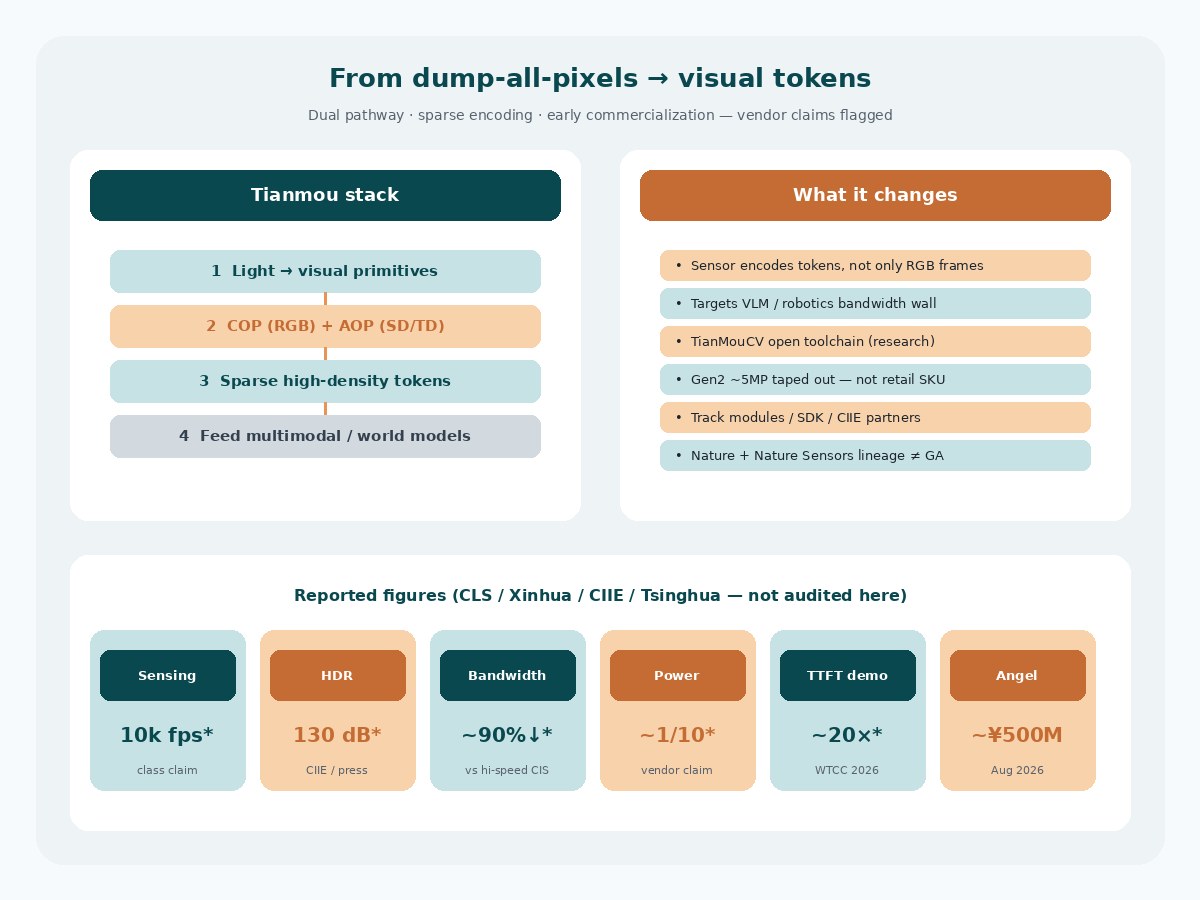
Dump-all-pixels vs token encoding. Asterisked fps / HDR / bandwidth / power / TTFT figures are from Chinese press, CIIE exhibit copy, and WTCC demos — not independently remeasured here.
The paradigm in engineering terms
Human vision does not photocopy the world at a fixed frame rate. Rod/cone specialization and parallel pathways trade detail against speed. Tianmou’s pitch is analogous at silicon level:
- COP — dense appearance (RGB / intensity), good for recognition when the scene is stable.
- AOP — sparse ±high-bit spatial and temporal differences with claimed high dynamic range, aimed at motion, flicker, and sudden events.
- Primitives → tokens — instead of only emitting frames, the stack can organize complementary cues into sparse visual tokens that align more naturally with Transformer inputs.
That last step is the product story Xijian is selling to multimodal and world-model teams: the sensor becomes a front-end token encoder, not merely a camera. Chinese coverage around the Nature Sensors work explicitly contrasts “acquire all pixels, then understand” with “acquire understandable information units.” Whether that holds outside lab and booth demos is the open question for integrators.
Headline numbers (vendor / exhibit / demo)
Across 科创板日报 (CLS), CIIE exhibit materials, Tsinghua explainers, and Xinhua’s WTCC 2026 Shanghai West Bund report (22–25 Oct 2026), the recurring claims are:
- ~10,000 fps-class sensing (CIIE: “per-second 10,000 frames,” described as 3–10× same-bandwidth sensors) — class claim, not a guarantee at full 5 MP RGB dump.
- 130 dB high dynamic range; CIIE also cites ~72% quantum efficiency and NIR-capable imaging.
- ~90% transmission bandwidth reduction and power about 1/10 of traditional high-speed CIS — relative to vendor-chosen baselines.
- First-token latency: financing coverage says tens of milliseconds for high-density visual tokens usable by large models; WTCC booth demos claimed response cut from nearly ~20 seconds on a traditional vision-model path to hundreds of milliseconds — “over 20×.” Those are different setups; both are vendor/demo figures, not a bake-off you can order tonight.
- Resolution path: Gen1 described around ~0.2 MP in some investor writeups; Gen2 taped out at ~5 MP for mass-production orientation.
Application messaging lists embodied robots, autonomous driving, industrial inspection (including hundred-microsecond-class anomaly capture), high-speed photography, and UAV inspection. Treat “already covering” language in Chinese fundraising pieces as target markets and early pilots, not as a validated multi-OEM volume statement.
Money and show floor
In late August 2026, CLS reported that Shanghai Xijian completed an angel round of nearly ¥500 million (~$70M at round-number FX), with investors including Xuhui science/innovation capital, Matrix Partners China (经纬创投), Chinese Media Capital (华映资本), Inno Angel (英诺基金), and a Tsinghua alumni seed fund. Coverage also says the company finished three rounds in roughly its first year for a cumulative total near that same ¥500M figure — read carefully: “angel near ¥500M” and “three rounds cumulative near ¥500M” are how Chinese outlets phrased it, not three independent half-billion rounds.
At WTCC 2026 on Shanghai’s West Bund, Xinhua described a live traditional-vs-Xijian vision-model comparison and a “chip–protocol–large model” full-stack pitch. CIIE’s online exhibit hall lists Tianmou with modules, algorithm SDK, development tools, and roadmap language for Token cameras and visual-token encoding accelerator cards aimed at multimodal / AI-compute partners. That is the honest overseas tracking surface: partners and SDK, not a consumer webcam.
What actually changes if it works
For teams already fighting camera pipes into VLMs and world models, the interesting shift is architectural. Today’s default is high-bandwidth CIS → ISP → dense tensors → model attention that spends most of its compute ignoring redundant pixels. A complementary-primitive sensor that emits sparse tokens moves filtering and encoding into the optical front end. That could matter for edge robots that cannot afford multi-gigabit camera fabrics, for industrial lines that need event-like temporal acuity without event-camera ecosystem lock-in, and for AV stacks that want HDR motion cues without drowning the backbone.
It does not automatically obsolete RGB cameras, event cameras, or LiDAR. COP still carries appearance; AOP is a different sparsity story than DVS polarity events; fusion stacks will still need calibration, drivers, and model retraining. The near-term overseas value is mostly conceptual and research: TianMouCV, the two cover papers, and a funded Chinese startup trying to productize the paradigm.
Honest caveats
- Vendor and booth numbers — 10k fps-class, 130 dB, 90% bandwidth cut, ~1/10 power, ~20× first-token demos, tens-of-ms token latency: all from Chinese press, CIIE copy, WTCC demos, or company-adjacent coverage. Not independently remeasured here.
- Early stage — Gen1 lit and Gen2 taped out is progress, not volume production with public lead times and datasheets in English.
- Academic ≠ product — Nature / Nature Sensors covers establish the paradigm and algorithm story; Xijian still has to ship modules that survive automotive/industrial qualification.
- No ClearSight-style invented brand — English references in this article use Xijian Technology and Tianmou as in Chinese primary sources; do not assume a global consumer trademark.
- Availability — track CIIE/WTCC partner materials and TianMouCV; do not plan a 2026 BOM around a Digi-Key order.
Bottom line: Tianmou is one of the clearest Chinese attempts to redefine the camera as a token encoder for Physical AI. Overseas robotics and VLM engineers should read the papers, watch the Gen2 module path, and stay skeptical of booth latency multipliers — while acknowledging that sparse complementary primitives are a real alternative to “ship every pixel and pray.”