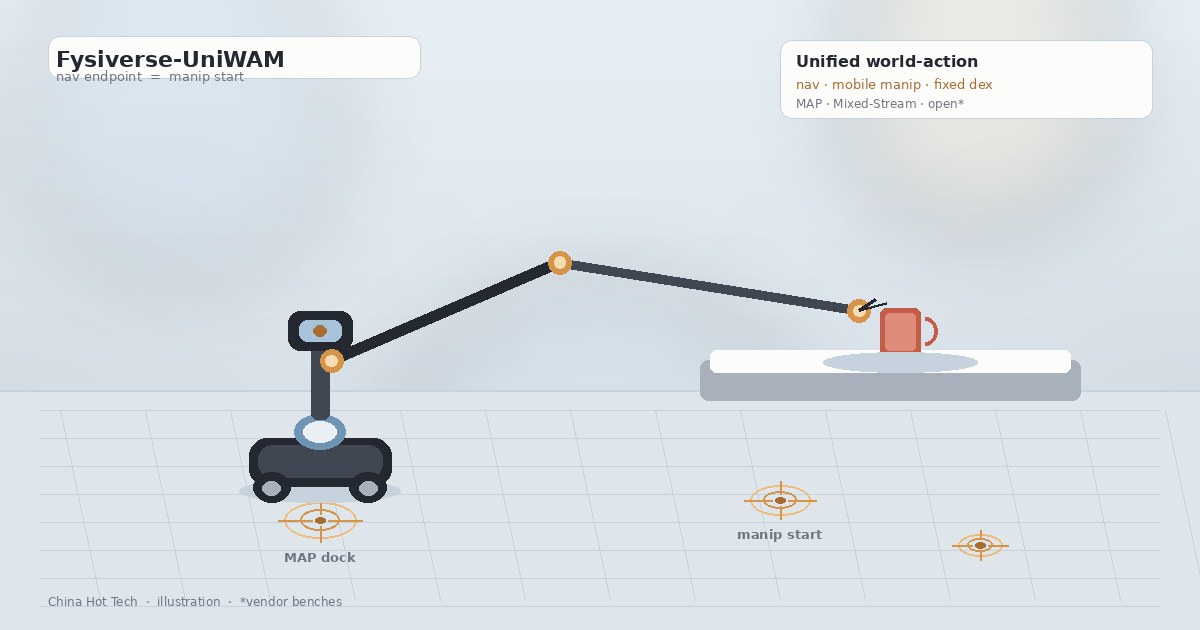
Mobile manip stacks usually fail at the seam: the navigator parks “near enough,” then a separate policy must rediscover where the arm should begin. UniWAM’s pitch is that one model can own navigation, mobile reach, and fixed-station dexterity if you give it a shared video/action backbone and an explicit anchor pose that turns a dock into a manipulation start. For overseas robotics and ML engineers the practical questions are open artifacts (yes), how MAP-Data was synthesized, whether MAP-Bench and real-robot tables hold up under your own protocol, and how this differs from other Chinese WAM drops you already bookmarked.
What UniWAM actually does
On the project page and paper framing, Fysiverse-UniWAM is a unified world-action model with three job families under one training story:
- Autonomous navigation — drive the base to a MAP pose with position and heading that are already useful for the next reach.
- Mobile manipulation — after (or with) that dock, run arm/object contact tasks on a wheeled or mobile platform.
- Fixed-station dexterous manipulation — a separate data stream for tabletop / fixed-base dexterity that still shares the video DiT + action DiT backbone.
Architecture-wise the team describes a Mixed-Stream setup: navigation and manipulation keep separate data streams, but share a video DiT + action DiT backbone through MoT (Mixture-of-Transformers), so streams can train independently without forcing one giant mixed batch of full mobile-manip trajectories. The inductive bridge is MAP — Manipulation Anchor Pose — the pose the navigator is trained to hit and the manipulator is trained to start from.
As code, weights, and data — yes: project fysics-ai.github.io/uniwam.github.io, paper arXiv 2609.39388, code GitHub Fysics-AI/UniWAM, weights HF Fysics-AI/UniWAM, plus MAP-Data and MAP-Bench. Treat it as a research drop — CUDA/sim/robot bring-up still on you — not a one-click hobbyist kit or a managed fleet API. As a robot you can buy — no. Not a Digi-Key SKU and not a RaaS meter; the overseas deliverable is open software + datasets.
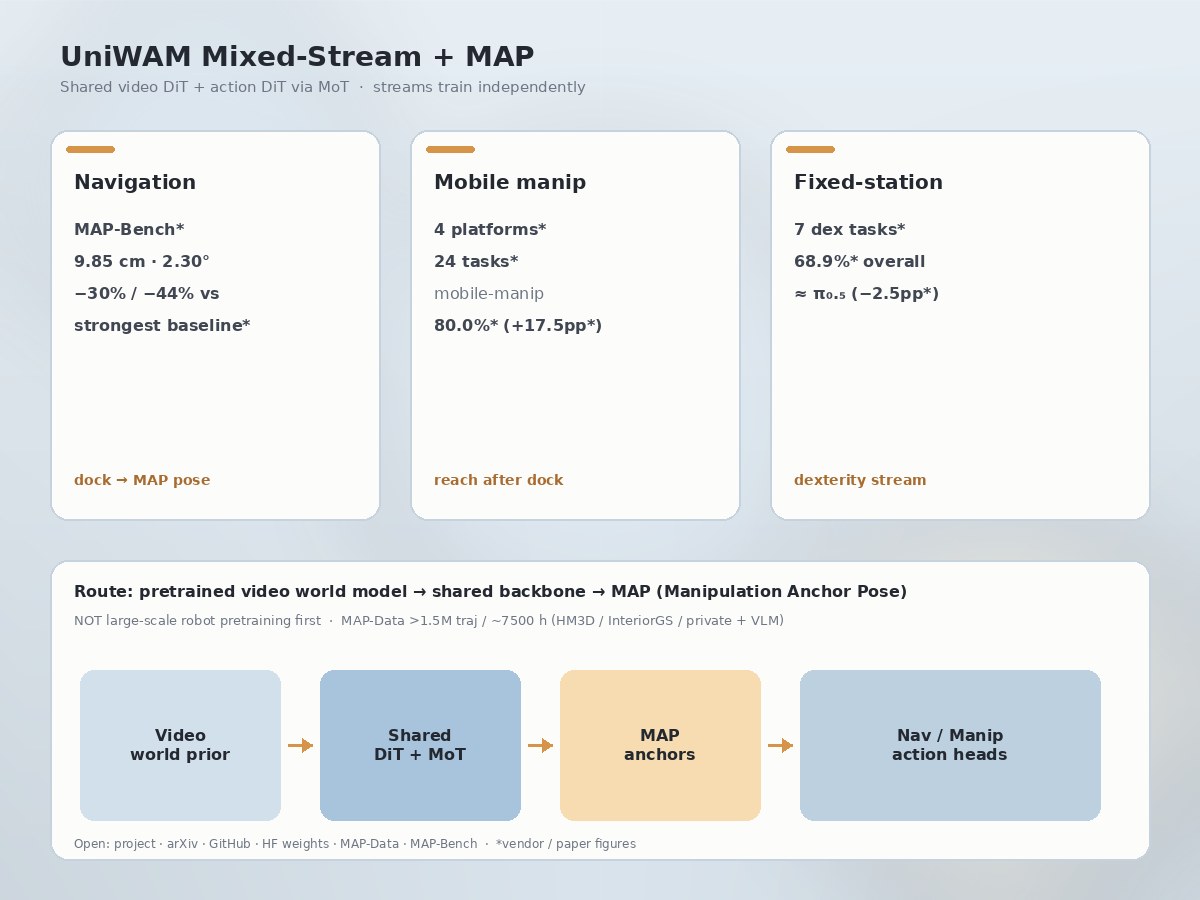
Mixed-Stream cards + MAP pipeline. Asterisks mark vendor/paper benches; MAP-Data scale and real-robot means are team-reported.
MAP-Data and MAP-Bench*
Instead of leading with months of teleop on every mobile-manip combo, UniWAM leans on MAP-Data: more than 1.5M trajectories and roughly 7500 hours, auto-generated via HM3D / InteriorGS / private scenes plus VLM labeling and path planning*. That synthetic-first path is the data story overseas labs will want to stress-test — useful if it transfers; fragile if the generators leave a fingerprint your real kitchen does not share.
On MAP-Bench the team reports average position error 9.85 cm* and heading 2.30°*, improving on the strongest external baseline by about −30.1%* position and −44.0%* heading. A related zero-shot transfer claim: UniWAM-Sim trained on MAP-Data only (no real demos) hits roughly 18.7 cm* / 6.34°* on real robots — the gap between sim-anchor accuracy and real dock quality is itself the figure to reproduce.
Real robots: 4 platforms, 24 tasks*
Reported physical eval spans four platforms and 24 tasks*:
- 13 navigation tasks — UniWAM ranks #1 on position error* across all 13 in the team’s comparison table.
- 4 mobile-manipulation tasks — all #1 on success*; UniWAM-Scaled averages 80.0%* success, about +17.5 percentage points* versus π₀.₅ under their protocol.
- 7 fixed-station dexterity tasks — overall 68.9%* success, close to π₀.₅ (−2.5 pp*) — competitive on the shared backbone without claiming a blowout.
Read those as lab/paper protocol*, not a third-party audit: embodiment set, success criteria, and π₀.₅ setup details live in the paper and project materials. The scientific claim worth carrying into your own lab is the MAP seam — nav quality measured as manip-ready pose, not only as map localization.
What changes for an overseas stack
If you already run OpenPI / π₀.₅, other WAMs, or separate nav + manip stacks, UniWAM changes three concrete checks:
- Can you use it — yes for research: clone GitHub, pull HF weights, and work with MAP-Data / MAP-Bench rather than waiting on a closed demo reel.
- What it changes — the nav endpoint is trained to be the manip start (MAP), so you may need fewer full mobile-manip trajectories if Mixed-Stream + synthetic MAP-Data transfer; fixed-station dexterity can ride the same backbone on its own stream.
- What to reproduce first — MAP-Bench pose/heading, the sim→real zero-shot dock numbers, and the mobile-manip delta vs your own π₀.₅ baseline under matched cameras and success definitions.
ChinaHotTech covered X-Era AI E0.5 on Oct 31 — a geometry-native future-3D WAM on VGGT-Omega. UniWAM is a different line: video-world prior + MAP anchors + Mixed-Stream MoT across nav/manip. Same broad “world-action” family; different inductive bet and open artifacts. Do not merge the two when skimming Chinese embodied-AI headlines.
Caveats
- Vendor / paper benches* — MAP-Bench errors, % deltas vs baselines, real-robot success means, and hour counts come from team materials and 机器之心 coverage; not independently re-run here.
- Synthetic MAP-Data* — HM3D / InteriorGS / private + VLM generation is powerful and also a domain-gap risk; treat transfer claims as hypotheses until you log your own docks.
- π₀.₅ comparisons* — mobile-manip +17.5 pp* and fixed-station −2.5 pp* depend on the paper’s protocol; match embodiments and metrics before citing as a leaderboard win.
- Research software — open does not mean plug-and-play on every mobile base; expect CUDA, sim, and integration work.
- Not a product SKU — no commercial robot, no hosted control API, no Digi-Key board.
- Licensing — read GitHub and HF cards for code/weights/dataset terms before shipping anything derived.
- Distinct from X-Era E0.5 / ViGAR — different teams and designs; keep the bookmarks separate.
Bottom line: Fysiverse-UniWAM is Fysics AI and Fudan CITLab’s open bet that a video-world prior, a shared MoT backbone, and explicit Manipulation Anchor Poses can unify navigation with mobile and fixed manipulation without waiting on a full mobile-manip teleop mountain. Overseas labs can pull code, weights, MAP-Data, and MAP-Bench today — and should keep asterisks on every centimeter, degree, and success rate until those numbers show up on their own floors.