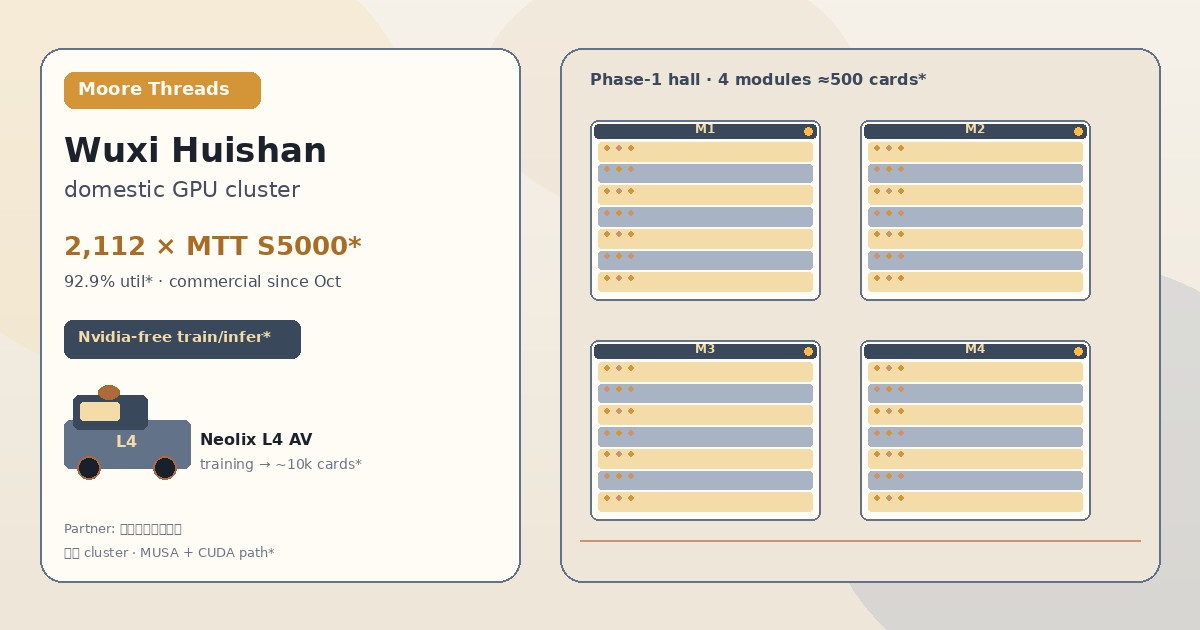
Most “domestic GPU cluster” stories stop at ribbon-cutting. Wuxi Huishan published running numbers: cards installed, utilization, paid share, workload mix, and a named AV customer aiming toward ten-thousand-card scale*. For overseas engineers watching China’s Nvidia-constrained path, the question is whether a full-function Chinese GPU stack can stay busy on real train and infer jobs after the press tour leaves.
What is live in phase 1
Per 智东西 / 芯东西 (2026-11-02) and Securities Times / 同花顺 field notes, the Wuxi (Huishan) center was planned at 万卡 scale, powered on in June 2026, trial-run in July (33 mainstream models cited*), and commercially operated from October. Phase 1 is four modular blocks of ~500 cards each: 2,112 MTT S5000 cards in 264 servers on Moore Threads’ 夸娥 (QuE) cluster stack*.
Disclosed operating snapshot*:
- ~92.9%* compute utilization; paid compute share ~59.7%* (operator also described “~100% including test users” with a queue).
- 55 customers engaged; 20+ already testing or in production; dozens more waiting to enter test*.
- Workload mix: training >62%*, combined train/infer 14.7%*, inference 23.1%* — useful if you have been assuming Chinese GPUs only do decode.
- Ten enterprise/university compute agreements cited across model training, embodied AI, AI video, spatial intelligence, life science*.
Huishan sits in the Yangtze River Delta as an “East Data West Computing” southern Jiangsu hub node — close enough to local industry and labs that iterative adaptation is a distance advantage.
Token numbers vs H800* (operator benches)
Huishan Investment Promotion Group and co-investor China Mobile Cloud disclosed DeepSeek V4 Flash measurements on the MTT S5000 pool* (7K in / 2K out): single-machine output ~994.97 tokens/s*, effective output ~1,241 tokens/s*, SLA-compliant max concurrency 48* streams — framed as ~92% of Nvidia H800* on that concurrency metric — with memory bandwidth 1.6 Tbps* and memory unit price “less than half of H800”*. Operator/press figures under named conditions; “H800-class” here is concurrency/SLA, not a blanket FLOPS claim. Card marketing (MUSA “Pinghu”*) also cites ~1,000 TFLOPS* dense AI (precision often unspecified), 80 GB* memory, 1.6 TB/s* BW, 784 GB/s* interconnect, FP8–FP64, PyTorch / vLLM*. Asterisk the datasheet slides.
As a procurement SKU on Digi-Key or a Western public cloud — generally no. This is a China compute-center / partner-channel deployment (Moore Threads + Huishan Investment Promotion Group + China Mobile Cloud), not a board you order for a US rack. As a signal — yes: a commercially billed, Nvidia-free* train/infer hall at >90% util* with an L4 AV customer planning toward ~10k cards* is the kind of operating evidence export-control watchers and China-stack evaluators actually need. Moore Threads’ dual-stack story (native MUSA plus a CUDA-compatible path*) is the migration claim to pressure-test if you ever get machine time; Langjing Innovation’s simulation/world-model work is cited as a migration case where results allegedly matched their prior path after adaptation*.
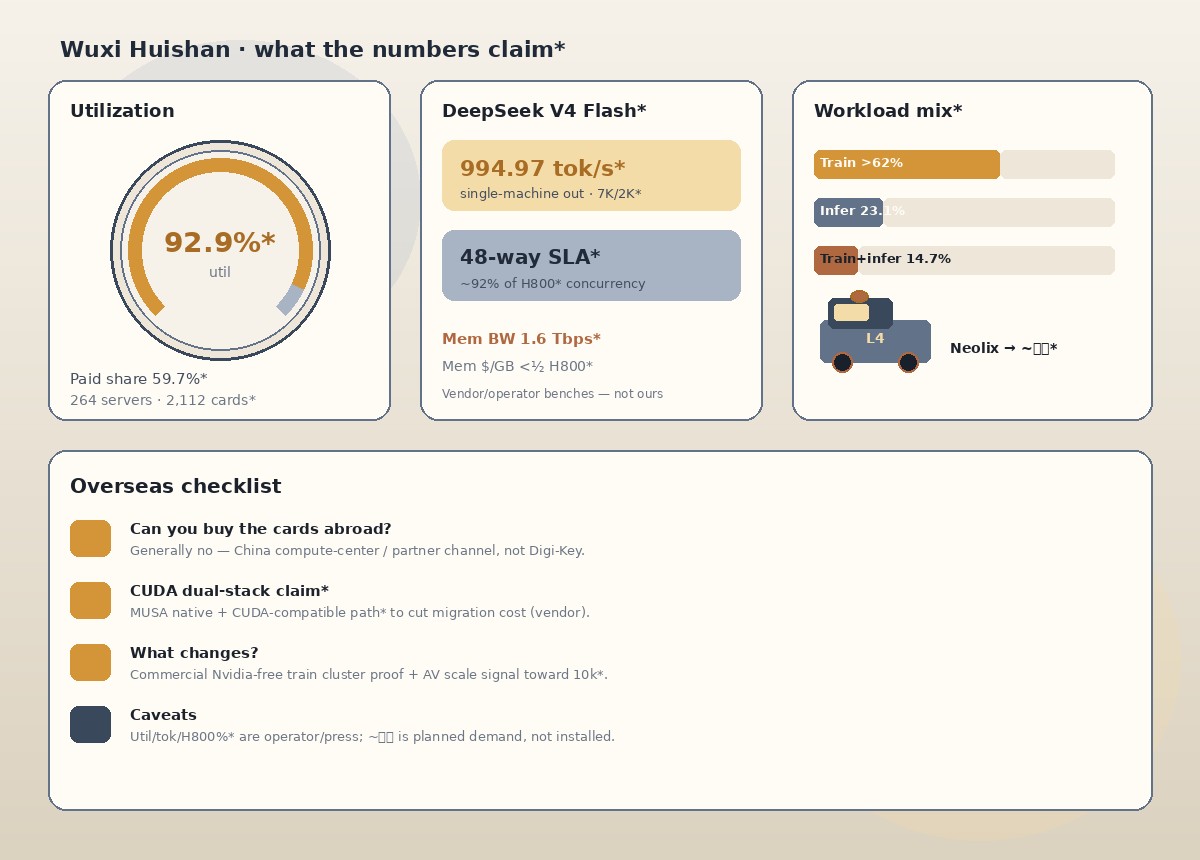
Util / tok·s / mix / overseas checklist. Asterisks mark vendor, operator, or press figures — not independent China Hot Tech benches.
Neolix L4 AV and the path to ~万卡
Around the World Internet of Things Expo (~2026-10-31), Moore Threads, Huishan Investment Promotion Group, and Neolix signed a strategic deal. Neolix has validated AV model training on MTT S5000 here and says larger runs need near-万卡 compute* (~5× installed). Same-day notes put Neolix’s East China unmanned-vehicle HQ in Huishan at ~RMB 1 billion* planned — HQ spend ≠ a locked GPU PO; treat ~万卡 as stated demand, not funded racks. Operators describe phase 1 at ~2k cards to raise acceptance and convert customers, then raise capital for phases 2–3 toward 万卡*. Expansion may mix heterogeneous / PD-separated inference (elsewhere Moore Threads cites “3× S5000 + 2× H20 ≈ 9× H20”* with ~1.87× throughput* / ~50% lower TTFT* vs H20-only*). Other MTT S5000 万卡 disclosures cite ~10 EFLOPS*, ~90%* effective train time, ~95%* linear scale* — vendor figures.
Full-function GPU angle (train + render + sim)
Moore Threads pitches MTT S5000 as a rare domestic “full-function” GPU: AI, graphics, physical sim, scientific compute, and video codec on one MUSA chip. For physical AI — AV, robotics, world models — train / synthetic render / sim often share a workflow; a matmul-only or raster-only card is a scheduling headache. That is the story Neolix and Langjing sit inside. Software ecology (debuggers, profilers, hiring, CUDA muscle memory) remains the hard part; dual-stack is the promised bridge, not a finished highway.
Caveats
- Not a Western retail / cloud SKU — China partner datacenter access; geo and channel constraints apply.
- Util / paid share / tok·s / H800%* — operator and press disclosures (Huishan + Mobile Cloud / 智东西 / Securities Times); not third-party audited benches published in full method detail.
- ~万卡 / Neolix scale-up* — strategic intent and stated demand; expansion still needs capital and delivery, not a completed PO.
- “Nvidia-free”* — describes this cluster’s GPU content per Chinese press; Moore Threads has also discussed hybrid S5000+H20 inference recipes elsewhere — do not confuse the Wuxi hall claim with a company-wide ban on Nvidia parts.
- TFLOPS / interconnect datasheet* — secondary coverage often omits precision and test harness; treat as marketing until primary whitepapers are public.
- 10万卡 + JD Cloud* — longer-range Moore Threads goal cited in the same coverage wave; separate from Wuxi phase 1.
Bottom line: Wuxi Huishan is one of the clearer public operating snapshots of a commercial Chinese full-function GPU train/infer hall — 2,112 MTT S5000*, ~92.9% util*, paid share ~60%*, training-majority mix*, plus an L4 AV customer pointing at ~万卡*. Read it as evidence that domestic clusters can fill and bill — not a Digi-Key SKU, and not an unverified H800 replacement across every workload.