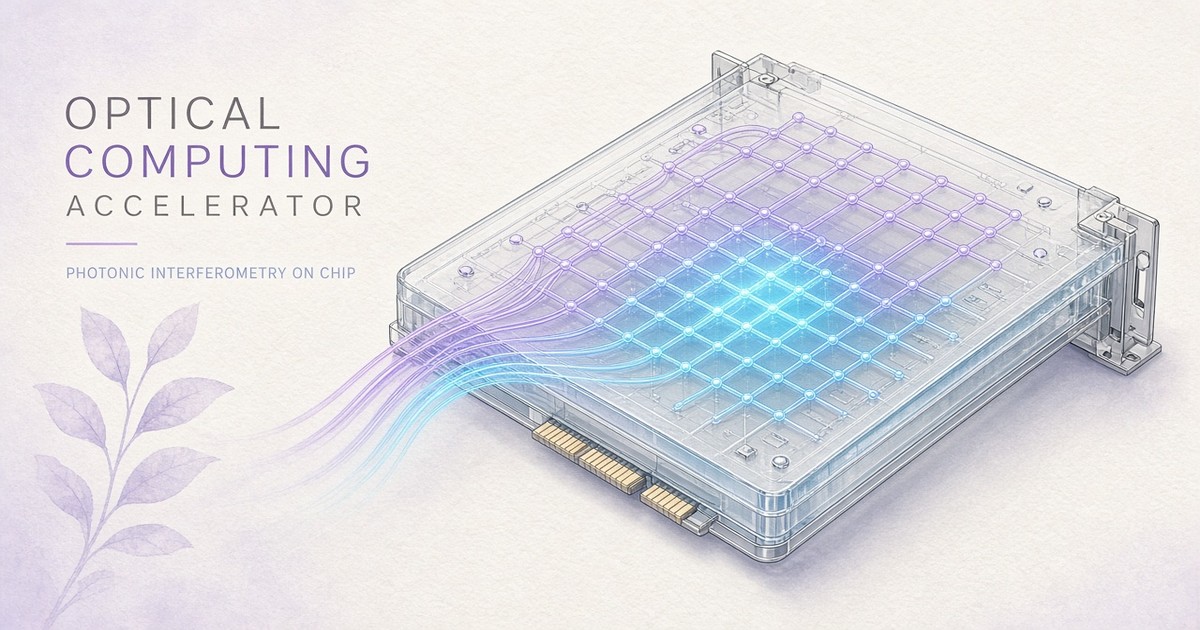
If you already know GPUs, the useful mental model here is not “another CUDA competitor.” It is matrix multiply done in light: interference and diffraction engineered so that optical propagation itself performs the dense linear algebra that dominates transformer inference. Electrons still handle control, I/O, and (usually) nonlinearity in hybrid systems; the bet is that the hottest, most parallel matmul can ride photons with a better joules-per-op curve — especially for inference energy at the rack edge and for sensing that never leaves the optical domain. That is the architecture story PhotonMatrix is selling. What you can buy today is mostly: watch the architecture, wait for boards, and treat every TOPS/W* as a vendor claim until silicon returns.
What the seed rounds actually signal
Coverage from 智东西 / 芯东西 (Nov 3) and 投资界 puts the latest raise in the 数亿元* (several hundred million RMB*) seed band, with five seed rounds* claimed since the May 22 founding. Named investors include 海桐国际创新中心, 云启资本 (Yunqi), 国泰海通, 险峰长青, 原子创投, 同鑫资本, and 上海交通大学AI未来基金* — proceeds for chip R&D / tape-out, hiring, and ecosystem*. Secondary write-ups float a “数十亿” valuation*; we do not lead with that — early optical-compute valuations in Chinese press are fluff until revenue and silicon exist.
The thesis is a reconfigurable all-optical photonic processor*: interference + diffraction hybrid, all-optical feed-in, nonlinear optical compute kept in-domain where possible, plus Chiplet so multiple optical cores scale under one programmable fabric*. English: PhotonMatrix; Chinese: 智子光垣. Calibration claims go to ~10−6 matrix error* with domestic foundry / OSAT* — claims, not independent benches.
No Digi-Key SKU, no Western cloud instance, no retail board you can order this week. Both product chips are described as sent to tape-out*, with deployable products planned within roughly ~6 months* (press / company timeline). Tape-out ≠ validated silicon. Expect China OEM / cloud / robotics design-ins first if anything ships.
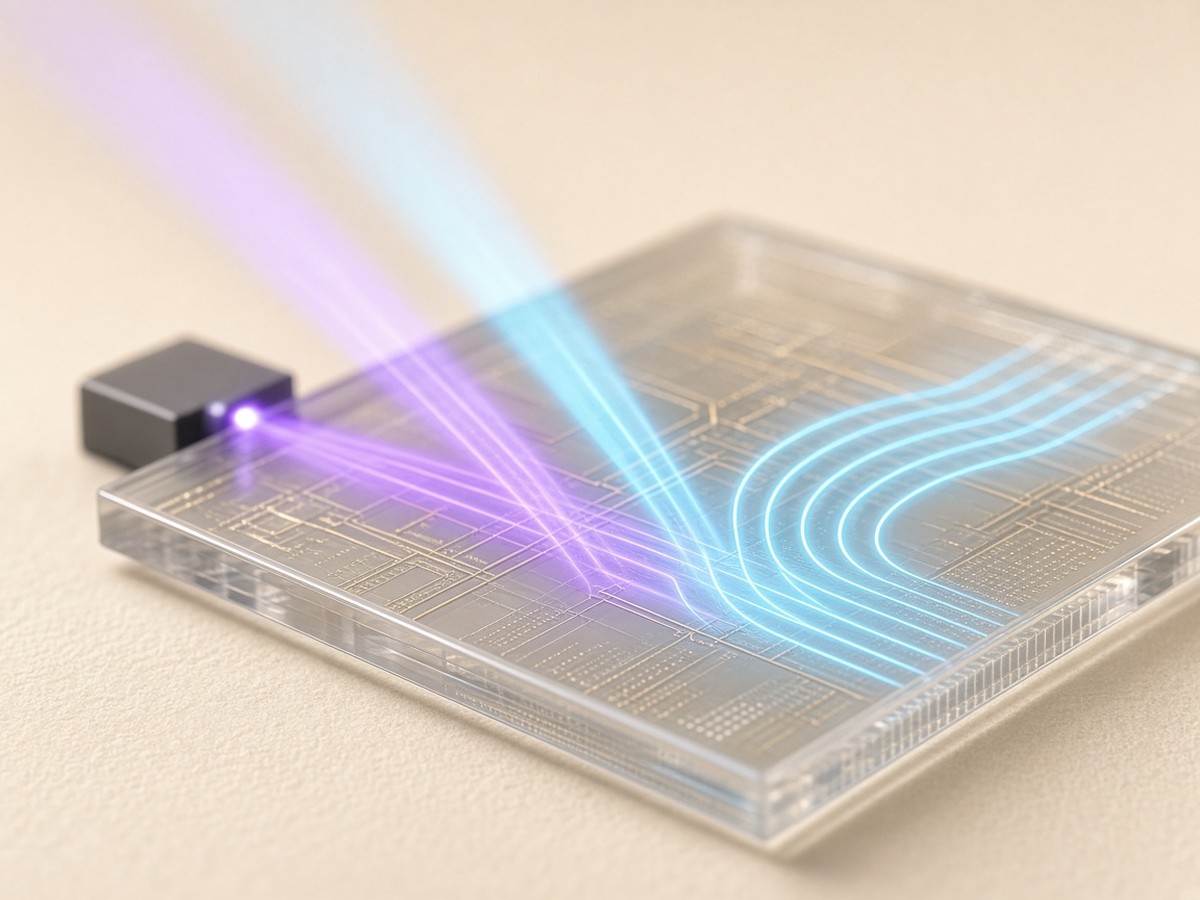
Light as the compute medium: editorial glass-slab still in the same violet-cyan lab palette. Specs in the article below are vendor / press figures*.
Zhulong OPU-08 — server photonic accelerator*
烛龙 Zhulong OPU-08 is the server / datacenter card: a reconfigurable optical compute core with electronic control and a standard server interface packaged as an optoelectronic accelerator board* (PCIe-class framing in press). Vendor numbers: 256×256 optical matrix*, 150 TOPS*, 30 TOPS/W*. Positioning is AI inference matmul — “photonic Token” language in 界面 coverage — not a claim that the card replaces a full GPU training stack tomorrow. For someone who already buys H100 / H200 / Ascend / Moore Threads cards, the interesting question is whether a photonic add-in can cut inference joules on the dense GEMM path once the software stack and calibration hold under rack noise. That answer does not exist in public silicon yet.
Xuanjian TOCU-07 — edge sense + compute*
玄鉴 Xuanjian TOCU-07 targets edge: a 128×128 optical matrix* at 100 TOPS* and 50 TOPS/W*, with optical sensing linked into the same optical compute path*. Pitch use-cases are robots, smart sensing, and edge devices where ambient or weak environmental light can participate in the compute rather than being ADC’d first*. That is a different engineering bet from “phone NPU with LPDDR” or “rack GPU with HBM” — it is sense-compute co-design in the optical domain. Same caveat: vendor energy numbers, pre-silicon.
Founder and research trail*
Cheng Yuan (程远): SJTU microelectronics PhD 2021, ex-Tsinghua postdoc, HKU visiting scholar, Alibaba DAMO researcher; now SJTU AI associate professor and PhotonMatrix founder (press also notes prior CTO work at edge-AI firm 辛米尔*). Chinese coverage mixes founder vs company tallies — Nature/Science-series papers*, 40+ top-venue*, 80+ patents* on the founder side; ~50 R&D*, dozens of prior optical tape-outs*, ~20 Nature/Science-series* on the company side. A 2025-08 Nature Photonics DTU paper with Tsinghua’s 戴琼海 / 方璐 (million-TOPS*-class diffractive compute*) is pedigree, not a product bench — keep paper TOPS and OPU/TOCU TOPS in separate columns.
Roadmap language (long-term*)
Beyond the two near-term SKUs, company / 界面 framing sketches a longer-horizon photonic “GPGPU” for train+infer near end-2027 / early-2028* — roadmap*, not a ship date. Optical computing’s hard eng problem remains consistency under noise, temperature drift, and manufacturing variation; soft/hardware calibration is what the company claims to industrialize*. Until boards return and third parties measure matmul accuracy under load, this is an architecture-and-capital signal on China’s non-GPU AI path — different from electronic near-memory or 3D-stacked edge TPUs covered elsewhere here.
Caveats
- Not Digi-Key / not shipping retail — no Western cloud SKU; China OEM / cloud / robotics path if products land.
- Tape-out ≠ validated silicon — both chips “sent to tape-out”*; deployable products ~6 months* is press timeline, not a confirmed board ETA.
- TOPS / TOPS/W* — Zhulong 150 TOPS* / 30 TOPS/W*; Xuanjian 100 TOPS* / 50 TOPS/W*; all vendor. Matrix sizes 256×256* / 128×128* likewise.
- Optical consistency / noise — still the hard engineering problem; calibration-to-10−6* is a company claim.
- Valuation “数十亿”* — press fluff; prefer seed-round and product architecture over valuation headlines.
- Paper ≠ product — Nature Photonics DTU million-TOPS* research pedigree is not the same as OPU-08 / TOCU-07 benches.
Bottom line: PhotonMatrix is arguing that AI’s densest linear algebra can move into reconfigurable optics — a server card for inference energy and an edge chip that couples sensing to optical compute — funded hard at seed while silicon is still at the foundry. Overseas engineers should read the architecture (interference + diffraction hybrid, Chiplet, all-optical feed-in*), asterisk every performance number, and wait for boards before treating this as anything you can schedule into a real workload.