Wi-Fi 7 headlines usually mean a living-room router: 320 MHz channels, multi-gigabit PHY rates, and a die that competes with Qualcomm or MediaTek BE-class AP silicon. That is not what AltoBeam put out. The ATBM6175 is a 数传 / data-transmission SoC whose published peak is 80 MHz channel bandwidth and 4096-QAM (MCS 13), for a PHY rate of 720 Mbps*. The news is that Wi-Fi 7 features — 4096-QAM, multi-link operation, and a hardware Bluetooth coexistence arbiter — are landing in the camera, TV, projector, and CPE module class AltoBeam already ships at volume, not that a new flagship AP chip just showed up.
The company posted the note on its official site (altobeam.com/contents/15/344.html; the article itself is timestamped Nov 3, while the homepage news card and mainland reprints landed Nov 5) and the same text circulated via its WeChat account. IT之家 and 第一财经 / Yicai carried the claims the same evening. AltoBeam calls ATBM6175 the first domestic Wi-Fi data-transmission chip supporting IEEE 802.11be*, and says the Wi-Fi 7 core technology is entirely self-developed*. Treat both as vendor statements until a third-party teardown or a public datasheet says otherwise.
What the note actually specifies
On paper the radio is a highly integrated wireless-communications SoC. The headline PHY configuration is 80 MHz + 4096-QAM (MCS 13)*, which AltoBeam locks to a 720 Mbps peak PHY rate* at that bandwidth. Versus Wi-Fi 6’s 1024-QAM, the vendor says 4096-QAM is a 20% PHY-rate lift* — a modulation-step claim, not a comparison against a 160 or 320 MHz Wi-Fi 7 AP. The note also says the part fully introduces MLO (Multi-Link Operation)*: multi-band / multi-channel cooperative transmission and intelligent load scheduling, with dynamic seamless switching between links*. The pitch is lower air-interface latency and jitter, extra redundancy when a channel is congested, and fewer instantaneous drops for audio/video plus control traffic*. The announcement does not name the exact band combination (2.4 / 5 / 6 GHz) or a spatial-stream count, and it publishes no receive-sensitivity or transmit-power figures in dB or dBm — so none are invented here.
Alongside the Wi-Fi 7 data path, the chip integrates classic Bluetooth (BT) and BLE dual-mode*. RF frontend and baseband are described as optimized for strong receive sensitivity and high-linearity transmit power*, again without numbers. High integration, low power, and fewer external parts* are the BOM talking points, aimed at helping OEMs move a compact module to Wi-Fi 7 without blowing the hardware envelope or the cost budget*.
China / OEM module and FAE path — not a Digi-Key or Mouser hobby buy tonight. Overseas teams that already pull AltoBeam radios through camera, TV, projector, or CPE ODMs can inquire via the sales contacts on altobeam.com. The public notes mention sample support through the business team but do not disclose a sample schedule, mass-production date, package outline, or module SKU for ATBM6175. Do not plan a board spin around an availability date that was never published. Every rate, coexistence, and “first domestic” claim below is a vendor statement until you measure it on your own AP, antenna, and Bluetooth traffic mix.
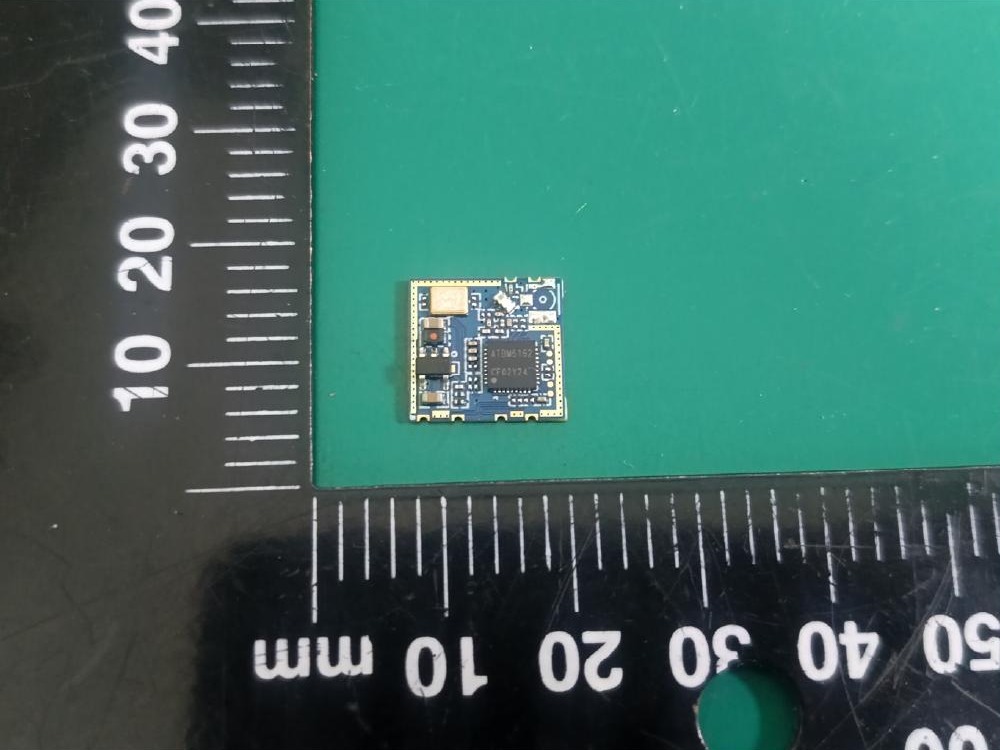
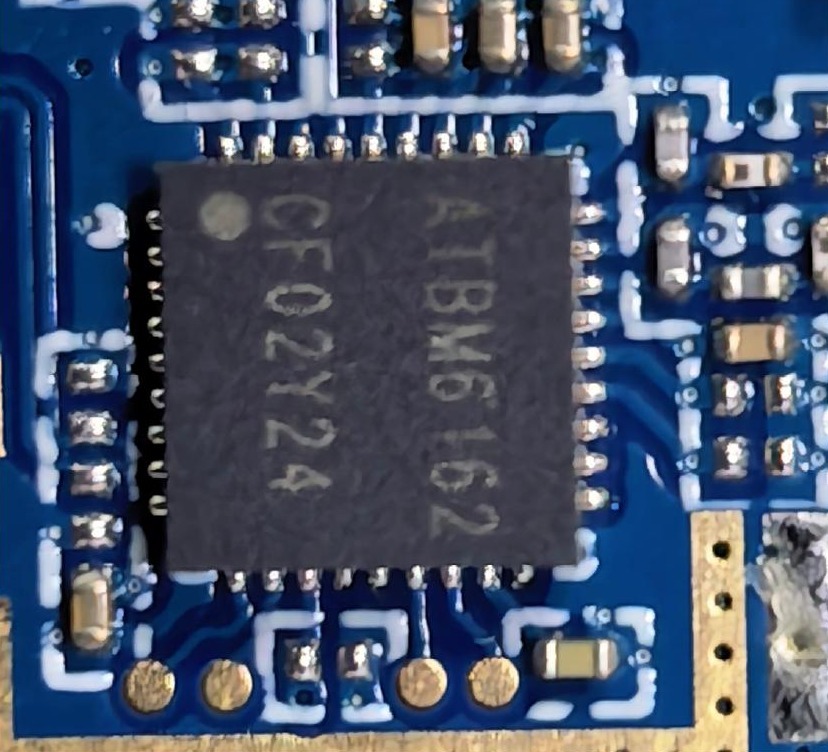
Not the ATBM6175. Public FCC external-photos exhibit of the related ATBM6162 Wi-Fi 6 + BLE module (roughly 12 mm class on the ruler) — the sort of compact data-transmission module AltoBeam already ships into cameras, TVs, and similar devices. Source: FCC ID 2BAVS-ATBM6162. Family shot, not a picture of the new Wi-Fi 7 die.
The coexistence bet
The longest stretch of the official note is not the 720 Mbps figure. It is 2.4 GHz coexistence. AltoBeam says it rebuilt Wi-Fi 7 and Bluetooth high-precision coexistence around a self-developed next-generation hardware block it names the Advanced Coexistence Arbiter*. The arbiter is claimed to have microsecond (µs) traffic awareness and dynamic priority*, and to distinguish Bluetooth A2DP audio, HFP voice, BLE / HID control events, and Wi-Fi 7 data packets so it can interleave timeslots* and cut same-channel interference in 2.4 GHz*.
The user-facing example is familiar if you have ever cast 4K video while a Bluetooth headphone or voice remote was also in the air: even when Wi-Fi 7 is near maximum downlink (the note cites 4K high-bitrate video and large downloads)*, the coexistence logic is still supposed to reserve protection slots for Bluetooth audio and control*. The promised result is fewer Bluetooth headphone dropouts and more responsive remotes or gamepads*. That is a software-plus-hardware story you can only judge on a crowded 2.4 GHz channel with your own peripherals — but it is also the feature that makes sense for the devices AltoBeam named, which almost always run a high-rate Wi-Fi pipe and a Bluetooth remote, headset, or HID device at the same time.
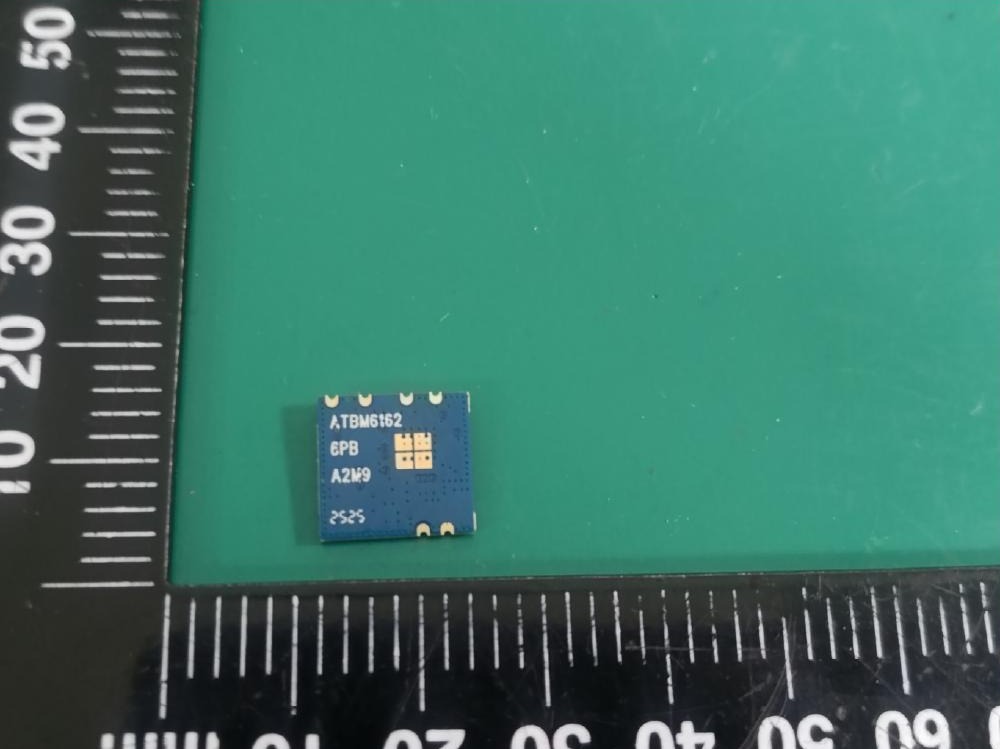
Module reverse of the same FCC ATBM6162 6PB unit, silkscreened with the older part number — included so the family context is unambiguous. ATBM6175 package outline and module SKU were not published with the launch note.
Where AltoBeam says it goes, and who the vendor is
Named target applications are consistent with a module-class radio rather than a router AP: 5G CPE and home / enterprise gateways* (as the LAN-side Wi-Fi hop off a cellular WAN, not as a multi-gigabit mesh node); smart projectors and mid- to high-end TVs*, where 4K casting or streaming is supposed to coexist with a Bluetooth voice remote*; in-vehicle terminals and smart cockpits* for media casting plus Bluetooth peripherals*; security and surveillance* for long-range high-bitrate 4K video backhaul*; and tablets and commercial terminals* that need a thin design, battery life, and throughput*. If you already put AltoBeam Wi-Fi into an IPC, a TV board, a projector, or a CPE, this is the upgrade path the company is describing.
AltoBeam was founded in 2007, with R&D and headquarters at Tsinghua Science Park in Beijing and branches in Shenzhen, Hangzhou, Chengdu, and Xiamen, per the company profile on its homepage. The current catalog covers Wi-Fi 4 / 5 / 6 / 7 data chips, Wi-Fi + BT / BLE multimode parts, ultra-low-power IoT MCUs, silicon TV tuners, and DVB and DTMB demodulators. The vendor’s own 2025 claim is that it was the world’s largest Wi-Fi chip supplier in wireless security / IPC* and among world leaders in smart-TV Wi-Fi chips* and TV silicon tuners*. The same blurb lists office printers, projectors, tablets, set-top boxes, home robots such as robot vacuums, and automotive multimedia screens* as additional sockets. Those share figures are company statements, not an independently audited ranking in the launch notes.
What changes (and what does not)
- Wi-Fi 7 features in a 数传 / module-class SoC — 4096-QAM (MCS 13)* + MLO* + a hardware BT coexistence arbiter*, not a 320 MHz multi-Gbps AP competitor.
- 80 MHz → 720 Mbps peak PHY* — meaningful for 4K streaming, casting, and camera backhaul if it holds; it is not a multi-gigabit routing number.
- 4096-QAM vs Wi-Fi 6 1024-QAM: +20% PHY rate* — vendor modulation-step comparison at the same class of channel, not versus flagship Wi-Fi 7 routers.
- MLO* — multi-band / multi-channel cooperative transmission, dynamic link switching, lower air-interface latency / jitter, and redundancy in congested channels*, as described. Exact bands and stream count were not published.
- Classic BT + BLE dual-mode* plus the Advanced Coexistence Arbiter* (µs traffic awareness, dynamic priority, timeslot interleaving of A2DP / HFP / BLE-HID / Wi-Fi 7 packets*) — the feature AltoBeam spends the most ink on.
- No public dBm / dB figures, package drawing, or sample calendar — RF “strong sensitivity / high-linearity TX*” is qualitative; do not invent numbers or ship dates.
- Target sockets* — 5G CPE and gateways, projectors and mid/high-end TVs, cockpit displays, security backhaul, tablets and commercial terminals*.
- Not a Digi-Key impulse buy — China OEM / module / FAE channel; overseas access is usually through an existing camera, TV, or CPE ODM, via altobeam.com sales.
Bottom line: if you already source AltoBeam radios into cameras, TV boards, projectors, or CPE modules, ATBM6175 is the first public signal that this vendor wants Wi-Fi 7’s higher-order QAM, MLO, and a hardware Bluetooth arbiter in that same compact, cost-sensitive socket — not a bid to displace flagship router silicon. Keep every megabit, “first domestic,” and coexistence claim asterisked, and wait for a package outline plus a sample before you redraw the module.