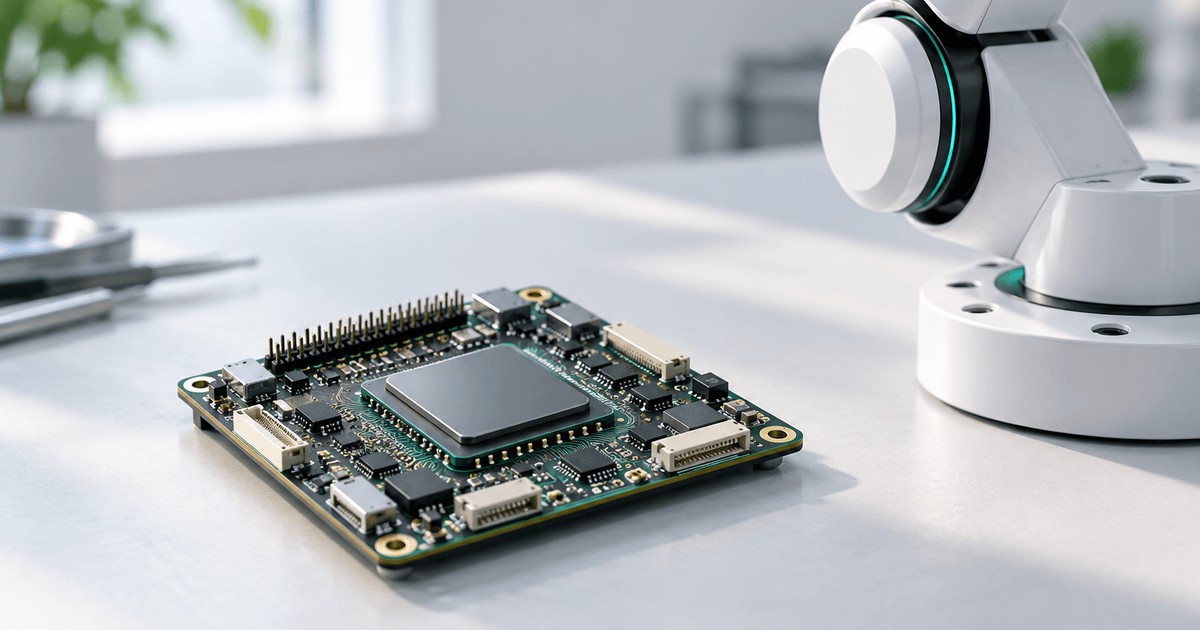
Humanoid and industrial robot teams still burn BOM and schedule on a familiar patchwork: an industrial PC or SBC for perception/ROS, a cluster of MCUs for hard realtime joints, and a separate EtherCAT / servo gateway tying the buses together. Each board wants its own DDR and eMMC; board-to-board links add millisecond-class jitter when you need microsecond force loops. SemiDrive’s D9-MAX pitch — and the Nov 6 open-source drop — is that the “cerebellum” job can sit on one car-grade die with silicon-level isolation between algorithm Linux, hard-realtime motion, and a safety island.
What landed on Gitee
Per 爱集微 / Jiwei (also on 老杳吧), the SDK is hosted under the gitee.com/SemiDrive org and managed as a multi-repo layout. Public trees called out in the release note include u-boot, Linux 6.12 LTS + PREEMPT_RT, dual rootfs options — Ubuntu 26.04 (ROS2 Humble / MoveIt*) and Buildroot 2502 — plus a cortex-r5 package shipping prebuilt Bin/ELF first with source promised later*, and a vendor/ tree carrying vendor/igh (IgH EtherCAT master adapted to their MAC*) and vendor/semidrive (HAL + the on-chip SRAM IPC library*). Treat performance and certification numbers below as vendor claims until you reproduce them on your harness.
Gitee SDK is public; production silicon and boards are still a vendor / partner path — not a Digi-Key hobby SBC you order tonight. Clone from gitee.com/SemiDrive (repos such as semidrive-manifest, semidrive-u-boot, semidrive-linux-6.12, semidrive-buildroot are already listed on the org). For hardware, SemiDrive’s earlier strategy materials point to a D9-Max application kit, and Radxa has announced a compact RoboX D9M (100×100 mm*) cerebellum board on the same SoC — useful as a possible eval path if Radxa opens volume sales, not as an Amazon impulse buy. Expect NDA roadmaps, industrial connectors (EtherCAT / CAN-FD / GMSL*), and car-grade qualification habits rather than Raspberry Pi forums.
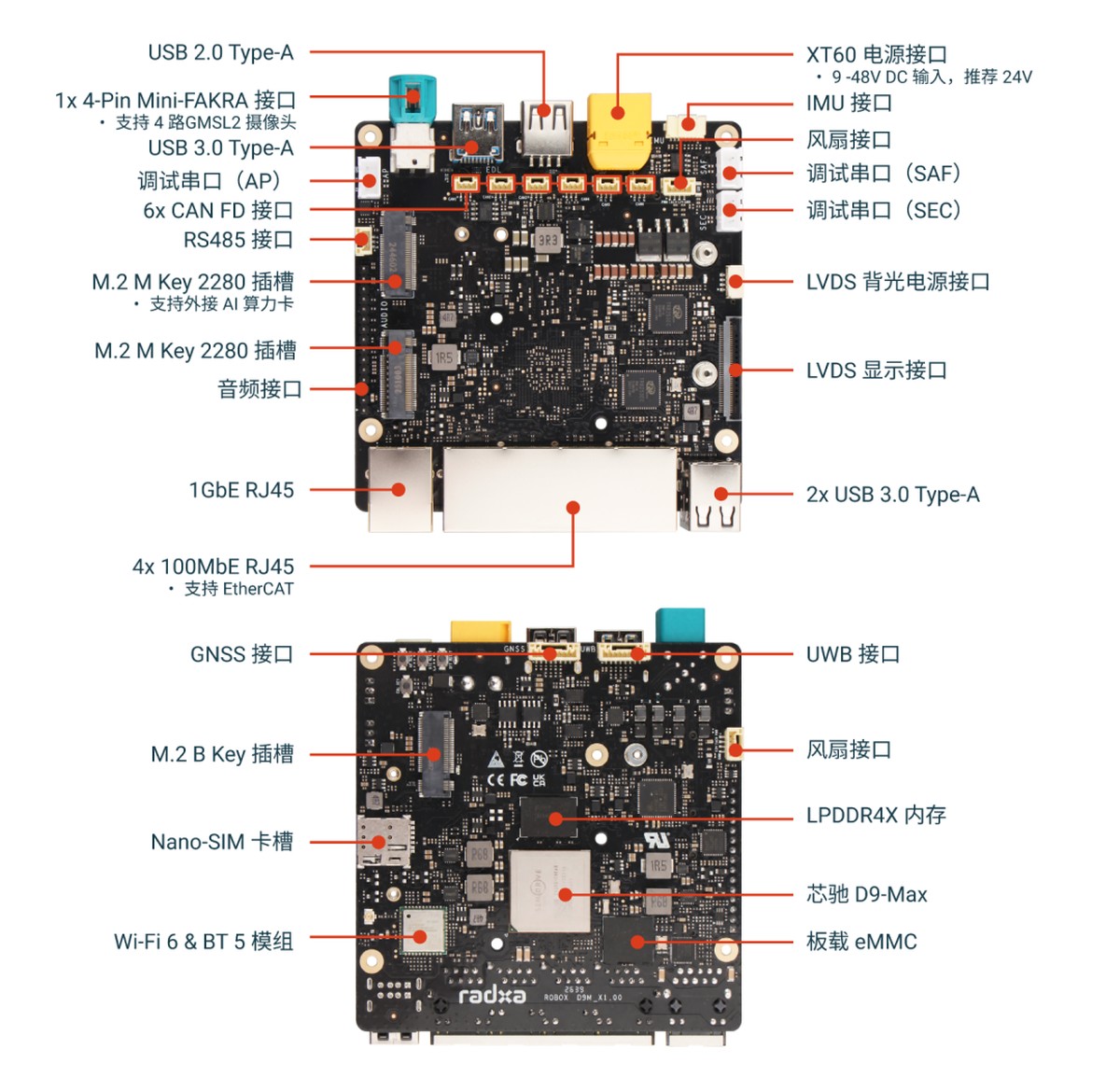
Real annotated product still from NE时代 RoboX D9M coverage — top/bottom of the Radxa board with SemiDrive D9-MAX marked (EtherCAT GbE, CAN-FD, GMSL2, M.2). Not AI art.
The single-die bet vs multi-board BOM
Jiwei’s write-up (sourced from SemiDrive) frames D9-MAX as a three-way on-chip split with hard isolation: an 8× Cortex-A55 cluster for Ubuntu / ROS2-class perception and HMI, a physically hard-isolated 4× Cortex-A55 cluster for realtime motion, and a safety island of 3 pairs of lockstep Cortex-R5F*. An 8 MB on-chip SRAM is pitched as the ns-class lock-free IPC / vNIC hub between domains*, so the story is one shared DDR + eMMC set instead of per-board memory. I/O claims in the same piece: dual GbE TSN (EtherCAT master capable*), 12× CAN-FD, 16× UART/RS485, PCIe 3.0 x2, and industrial/car temperature −40…105 °C*. Measured talking points from their SDK bring-up*: IgH EtherCAT running on the Linux domain; bare-metal 125 μs 6-axis control on a single A55*; ASIL-B functional safety plus Evita Full HSM*. Asterisk every one of those until your scope says otherwise.
SemiDrive’s May 2026 strategy note already positioned D9-Max as the embodied “cerebellum” next to a future R1 “brain” SoC and E3119-R joint MCUs, and claimed D9-series parts are already in volume at some humanoid makers* — unnamed. The Nov open-source drop is the software half of that pitch: less “trust our binary BSP,” more “here is the repo layout and the realtime vendor bits.”
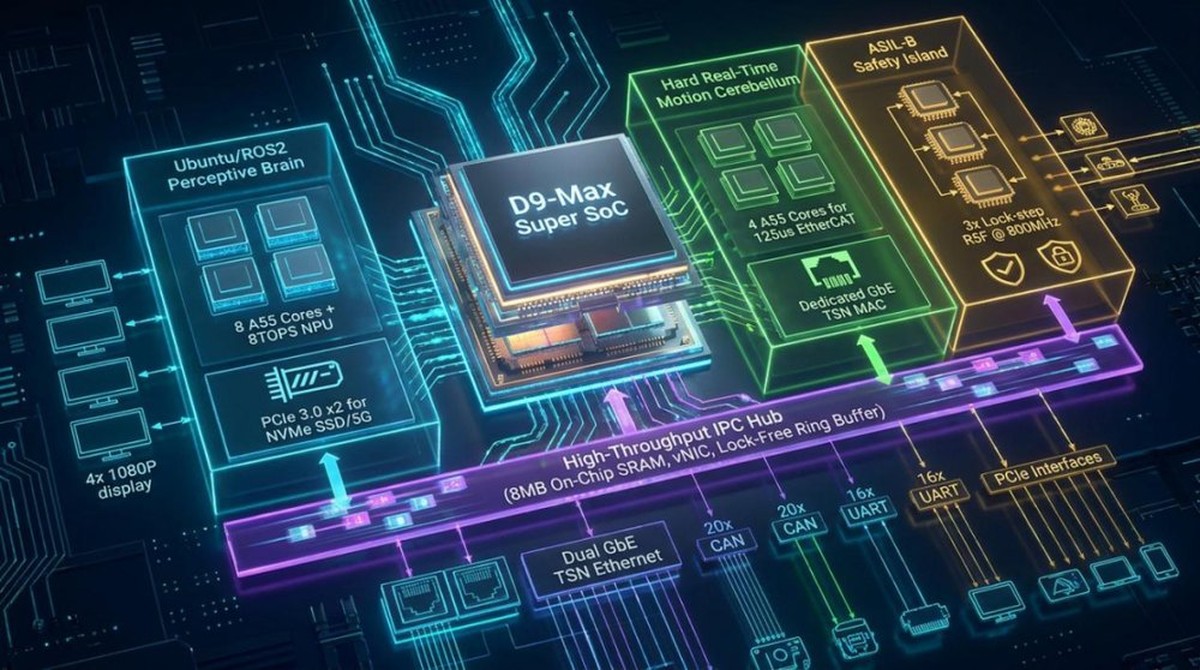
Real press still from 爱集微 / Jiwei D9-MAX SDK coverage (2026-11-06) — vendor architecture graphic for the dual-DSU + safety-island split and 8 MB SRAM IPC hub. Source still, not generated here.
What changes (and what does not)
- One die for perception Linux + hard-isolated motion + ASIL-B* safety island — vs IPC + MCUs + servo gateway boards and their duplicate memory.
- 8 MB on-chip SRAM IPC / vNIC* — vendor latency story (ns-class lock-free queues*); await your own cross-domain benchmarks.
- Dual GbE TSN / EtherCAT master*, 12× CAN-FD, 16× UART/RS485, PCIe 3.0 x2, −40…105 °C* — integration pitch for joint buses without a pile of bridge chips.
- SDK on Gitee* — u-boot, Linux 6.12 + PREEMPT_RT, Ubuntu 26.04 / Buildroot 2502, R5 prebuilts first*, IgH + SemiDrive HAL/IPC under
vendor/. - Claimed bring-up* — IgH on Linux domain; bare-metal 125 μs 6-axis*; ASIL-B + Evita Full* — asterisk until independent validation.
- Hardware path — SemiDrive kits + possible Radxa RoboX D9M; not a Digi-Key impulse board. D9 volume at unnamed humanoid makers* remains a vendor claim.
- Not a drop-in for NVIDIA Jetson / Qualcomm RB / x86 IPC stacks — different safety case, BSP, and industrial connector story; plan bring-up time around Gitee + vendor HAL, not Ubuntu Desktop defaults.
Bottom line: if your cerebellum BOM still looks like “mini-PC + motion MCU farm + EtherCAT gateway,” the D9-MAX open-source drop is the clearest public signal this week that a Chinese car-grade vendor wants that job on one isolated die — with a Gitee tree you can actually clone. Keep every microsecond, ASIL, and shipment figure asterisked, and budget time for board access and lockstep safety bring-up before you throw away the multi-board design.