If you work on a central compute / zonal architecture, the microcontroller that sits under the “brain” SoC — the part that has to close steer, brake, and suspension loops on a deadline, and still pass ASIL-D paperwork — is a short list. Infineon’s AURIX family and NXP’s S32 are the names most Western programs still write down first. A Chinese trade brief that 电子创新网 MCU加油站 (EETrend) carried on November 9, 2026, sourced from C*Core, and a matching 盖世汽车 (Gasgoo) note on November 10, argue that a Suzhou RISC-V part belongs on that same list: the CCRC4 series, which the company calls a central-domain “physical AI” MCU and a vehicle “cerebellum.”
The brief is a progress update, not a cold launch. C*Core (688262.SH; official English name C*Core Technology Co., Ltd.) already told investors on April 16, 2026 that internal tests of CCRC4XXX — previously known as CCFC3009PT — had succeeded and that two SKUs were with customers. The November materials add a flagship part number, lean on a China SAE prediction that 2027 will be the mass-production year for high-safety RISC-V automotive MCUs, and say the company wants to show up that year with chip, software, and tools together. The useful question for an overseas engineer is narrower: what is actually on the diagram, who already has samples, and what you still cannot buy off a Western cart.
What the official diagram and the filings actually list
The November brief names two compute SKUs, both RISC-V, both at a 500 MHz* ceiling:
- CCRC4088S — described as the flagship: an 8+4 core* RISC-V CPU, 14,000 DMIPS*, 24 MB RRAM and 10 MB SRAM*, plus precision analog, hardware routing, and a GTM timer module*, aimed at central-domain and intelligent-driving sockets*. This part number does not appear in the April 16 filing.
- CCRC4086S — a 6+6 core* RISC-V CPU, 10,500 DMIPS*, with an on-die NPU* for edge inference*. The official product page says those six-plus-six cores can be a set of six performance cores plus six lockstep cores, or recut if a customer wants a different split*. The same SKU is the one C*Core’s April filing described in the most detail, and the one already listed in SEGGER’s CCRC4086S device table.
The April filing also listed a smaller relative, CCRC4045S: 4+2 cores* at 400 MHz* and 5,600 DMIPS*, with 12 MB code and 512 KB data NVM* and 3 MB SRAM*, in BGA416*, with the post-quantum HSM but no NPU in that write-up*. The November brief does not mention 4045S. When those later notes say “two chips in the series have completed customer sampling,” they do not name the pair in the same sentence. The filing that does name a pair, in April, says 4086S and 4045S were already with customers for module work. We are not collapsing those two lists into one.
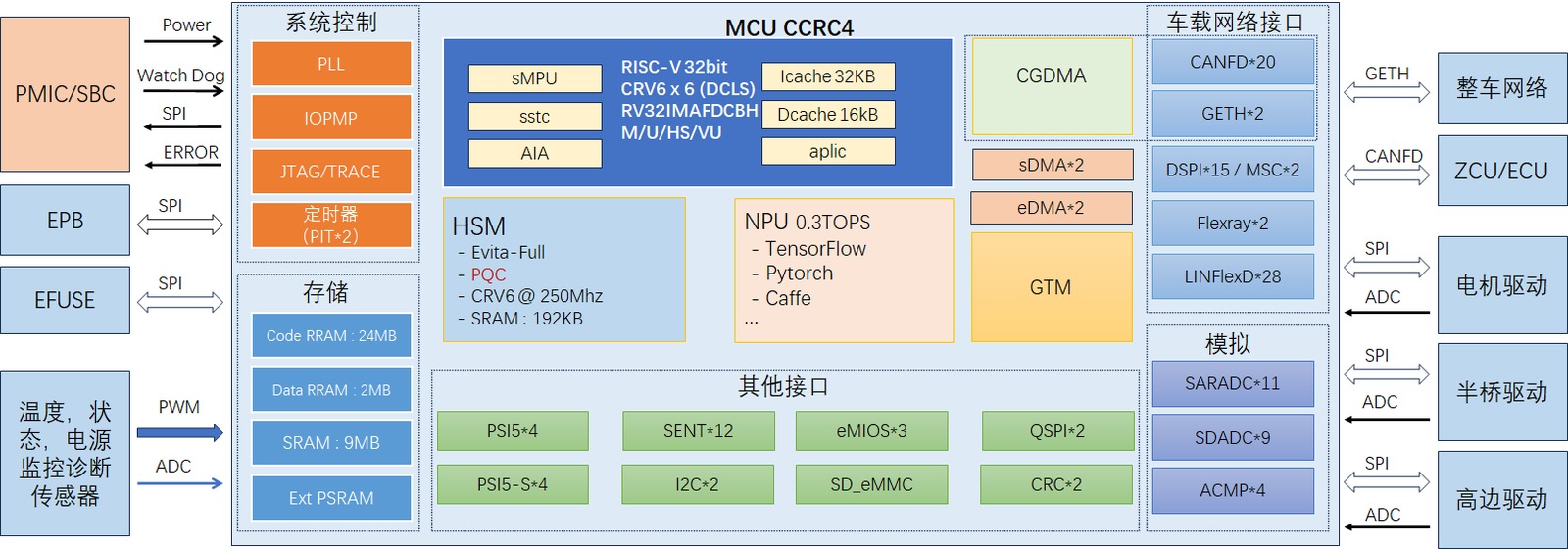
The official “MCU CCRC4” block diagram on C*Core’s product page is more specific than the press prose, and it reads like the 4086S-class die rather than an 8+4 flagship. In the center it draws a RISC-V 32-bit CRV6 × 6 (DCLS)* complex, ISA string RV32IMAFDCBH*, with privilege modes M/U/HS/VU* — machine, user, hypervisor-supervisor, and virtual-user, which is the company’s on-diagram way of advertising hardware virtualization*. Beside it sit an HSM marked Evita-Full*, PQC*, a CRV6 at 250 MHz*, and 192 KB SRAM*; and an NPU at 0.3 TOPS* with TensorFlow, PyTorch, and Caffe listed as supported frameworks*. Memory on the same drawing is 24 MB code RRAM*, 2 MB data RRAM*, 9 MB SRAM*, and an external PSRAM port*. Those memory numbers match the April filing for 4086S and the product-page text (“more than 9,000 KB” SRAM*). They do not match the November brief’s 10 MB SRAM* on 4088S. If you are quoting a SRAM figure, say which SKU you mean and get the datasheet.
The network and timing side of that same official drawing is the part of the pitch that matters for a vehicle-motion-controller socket: 20× CAN FD*, 2× gigabit Ethernet (GETH)*, 2× FlexRay*, 28× LINFlexD*, a CGDMA routing engine*, GTM*, plus PSI5, SENT, eMIOS, QSPI, and SD/eMMC blocks*. Analog is drawn as 11× SAR ADC*, 9× SD ADC*, and 4× analog comparators*. The November brief adds CAN-XL*, 10Base-T1S*, and TSN* for deterministic Ethernet, and says CGDMA can forward between CAN and Ethernet without waking the CPU*. Those last three do not appear as labeled boxes on the July diagram we retrieved; treat them as press-copy claims until a datasheet says the same thing in a register map.
Process and safety claims are consistent across the filing, the product page, and the November brief, and they are still vendor claims until you have the certificates: the die is on TSMC 22 nm RRAM* (the product page is the source that names TSMC), designed to AEC-Q Grade 1*, ISO 26262 ASIL-D*, and Evita-Full*, with a hardware security module that is supposed to run both classical and post-quantum algorithms*. C*Core’s sell on RRAM versus on-die eFlash is density, power, write speed, and a read-while-write path that is meant to make OTA less painful*. Packages are one of the messy spots: the April filing says BGA680 for 4086S and BGA416 for 4045S*; the current product page says BGA680 and BGA516* and “others.” Ask which ball-out you are actually being offered.
The November brief invites a comparison with Infineon’s AURIX RC1, which it says integrates up to twelve 32-bit cores and one edge-AI parallel unit*. That is a vendor-framed apples-to-oranges lineup, not a drop-in claim, and not a benchmark we have run. 0.3 TOPS* is a small NPU if your mental picture of “physical AI” is a cockpit or driving SoC; it is a more serious number if the job is a domain controller that wants a little on-die inference next to lockstep control. C*Core’s own earlier tape-out note, when the part was still called CCFC3009PT, talked about AI-assisted radar post-processing and BMS tasks — classification, free-space, micro-Doppler, and similar — not running a cabin multimodal model.
Not from a Western catalog click — samples have been going through C*Core since spring. Searches on November 10, 2026 for CCRC4086S, CCRC4088S, CCRC4045S, and CCRC4 did not return a Digi-Key or Mouser catalog product page we could use. The path the company points to is its own site, china-core.com, and its automotive design-support pages. The April 16 filing said CCRC4086S and CCRC4045S had already been sampled for module development; a June 17, 2026 investor reply added that those models had also obtained an OEM design-win (定点), without naming the automaker. The November brief says module work and in-vehicle calibration with domestic OEMs and Tier 1s are underway, with a turnkey chip-plus-software-plus-tools package aimed at 2027*. No public price, MOQ, or exact mass-production month appears in the materials we retrieved, and we are not inventing any. One practical overseas breadcrumb: SEGGER already lists CCRC4086S as a J-Link / Flasher target, which is a tool-chain signal, not a shipping-channel signal. C*Core’s older ASIL-D CCFC3 parts are already described, in earlier company coverage, as being in volume in powertrain and chassis controllers — including brake-by-wire and steer-by-wire — and as having reached Chinese OEMs and some international Tier 1s on those previous products. That is not the same thing as CCRC4 being orderable for a 2026 build.
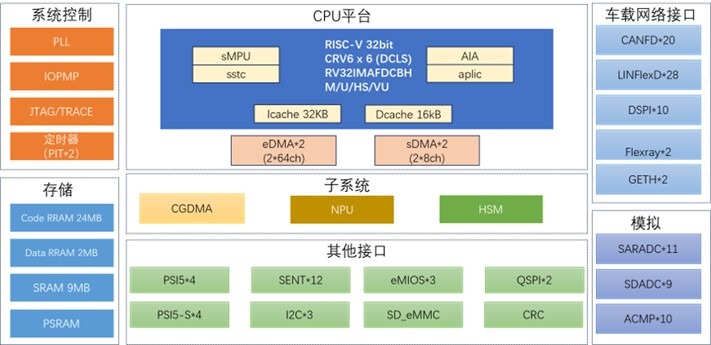
Official C*Core schematic published as “图1:CCFC3009PT架构示意图” in the company’s October 9, 2025 tape-out note, when the same RISC-V domain MCU still carried the CCFC3009PT name. It is an earlier, simpler official drawing of the same family — useful as a baseline next to the July 2026 “MCU CCRC4” diagram above, which adds the 0.3 TOPS, Evita-Full / PQC, and GTM labels. Vendor marketing art, not a photograph of silicon.
Who the vendor is
C*Core — 苏州国芯科技股份有限公司 — is a Suzhou embedded-CPU and chip-design house founded in 2001 and listed on the STAR Market as 688262.SH. Its public catalog sits in information-security and automotive/industrial control. The automotive side grew up on PowerPC-derived C*Core CPUs (the CCFC2 / CCFC3 domain and chassis parts); CCRC4 is the company putting a RISC-V CRV6 complex, an NPU, and a post-quantum HSM on a 22 nm RRAM die and pointing that die at the central-domain and cross-domain socket. General manager 肖佐楠 (Xiao Zuonan), quoted in the November brief, describes the job as catching the driving computer’s decisions, scheduling drive / brake / steer / suspension, and moving the data that comes with vehicle-to-cloud coordination — and claims that capabilities “international competitors’ new products already have” are in CCRC4, with post-quantum cryptography as the extra. That is a sales quote, not a teardown.
The November note also reminds readers that CCRC4086S made a 2026 China automotive-chip innovation list and a Gasgoo Golden Collection award*. Awards are not qualification evidence. The more concrete continuity is the CCFC3 ASIL-D line the company says is already in volume in powertrain and chassis, which it wants to sell as a high/low pairing with the new RISC-V parts.
What changes (and what does not)
What changes, if the silicon and the certificates match the diagrams, is that a Chinese RISC-V MCU with lockstep, a small on-die NPU, a serious-looking network set (20× CAN FD, dual GbE, FlexRay, a claimed TSN/CAN-XL path), and a post-quantum HSM is now in at least some OEM labs, with an explicit aim of being production-ready in the 2027 window the China SAE has flagged for this class of part. For a team already using C*Core in chassis or powertrain, or a Tier 1 that has to quote a China-market zonal controller, that is a reason to request the 4086S datasheet and ask how virtualization, CGDMA, and the HSM are actually exposed in software. Hardware lockstep plus hardware virtualization, if they work as advertised, is the company’s answer to “several domains sharing one MCU.”
What does not change is the homework, and the calendar. This is not a documented drop-in for AURIX or S32, and the November AURIX RC1 comparison is a slide, not a migration guide. 0.3 TOPS* will not replace a driving SoC. The April filing itself warned that third-party testing was still in progress and that customer bring-up could still surface problems. The 4088S flagship, the 10 MB SRAM figure, the BGA516-versus-BGA416 package line, and which two SKUs are “the” sampled pair are not fully reconciled across C*Core’s own documents. There is no Digi-Key page. 2027 is a target, not a packing list. Get the PDF, ask which ball-out and which memory map you are buying, and treat PQC, ASIL-D, and Evita-Full as claims to be checked against certificates — then decide whether this cerebellum belongs on the board.