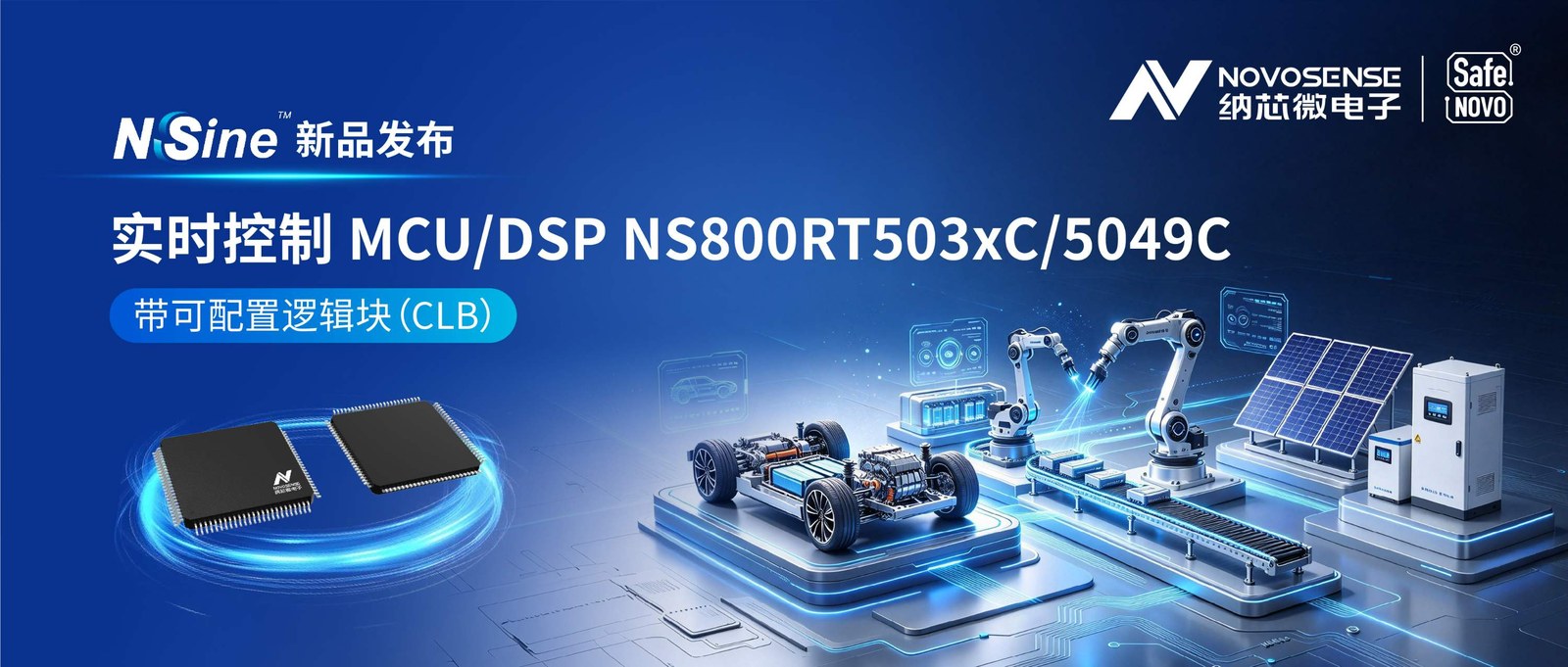
If you have spent years parking a small CPLD or a modest FPGA next to a real-time control MCU — just to decode EnDat or BiSS, to turn an absolute encoder into a quadrature stream, or to combine trip sources into a PWM inhibit — Novosense is pitching a way to fold that “little logic” into the controller itself. A Chinese product note carried by 电子创新网 (EETrend) on November 5, 2026, and matching official launch graphics, introduce the NS800RT503xC and NS800RT5049C members of the NSSine™ real-time control MCU/DSP family: Arm Cortex-M7 parts at up to 240 MHz* that add four configurable logic blocks (CLBs)* on top of an already-produced mid-range platform.
The “C” in the part number is the point. Novosense says the four blocks can be designed in software, wired through a crossbar to ePWM, eCAP, eQEP and GPIO*, and run as on-chip hardware in parallel with the CPU, so encoder protocols and PWM protection logic no longer have to leave the package for an external CPLD or FPGA*. Texas Instruments has shipped Configurable Logic Blocks on C2000 devices for years, and the peripheral names on this family — ePWM, eCAP, eQEP, CLB, SDFM, HRPWM — will look familiar to anyone who has lived in that catalog. Familiar is not compatible. The launch materials do not claim pin compatibility, register compatibility, or a C2000 software shim, and neither do we.
What the November materials actually list
The official family graphic in the press package, labeled “NSSine™ 系列实时控制MCU/DSP,” marks two mid-range boxes as New!: NS800RT5049C and NS800RT503xC. Both are drawn as a Cortex-M7 with a double-precision FPU at 240 MHz*, with four CLBs*, 32-channel ePWM* and 16-channel HRPWM at 124 ps* resolution*. Memory and analog then split:
- NS800RT5049C — 512 KB Flash*, 384 KB RAM*, three ADCs with 29 channels at 4.375 Msps*, CAN FD*, SDFM(H)*, in LQFP64 and LQFP100*. The graphic aims this SKU at tighter digital-power, servo, and automotive sockets, which matches the press copy.
- NS800RT503xC — 512 or 256 KB Flash* (the 512 KB part is NS800RT5039C, the 256 KB part is NS800RT5037C), 384 KB RAM*, three ADCs with 32 channels at 4.375 Msps*, CAN FD*, QSPI*, SDFM*, in (H)LQFP48 / 64 / 80 / 100 / 128*. The press note adds QSPI execute-in-place for off-chip memory* and “up to 67 GPIO”* on this sub-family, a GPIO figure that does not appear on the family graphic.
Keep two disagreements in view before you copy a number into a schematic. The press body says the C series offers “up to 512 KB Flash and 256 KB SRAM”*. The official graphic next to that text says 384 KB RAM* on both new boxes. The company’s older public selector for the non-C NS800RT5039 / 5049 / 5037 parts lists 388 KB SRAM with 256 KB of TCM*. We are not picking a winner. If you request a sample, ask whether 256 KB is the TCM slice, a typo in the press copy, or a different map on the C die.
Clock is the other place the C suffix is not a free upgrade. On the same official graphic, the non-C mid-range NS800RT5049 and NS800RT5037/5039 boxes still show 260 MHz*. The new C boxes are drawn at 240 MHz*, which is also the “maximum operating frequency” in the press note. Treat the C-series clock as 240 MHz* unless a datasheet says otherwise. The ADC sample-rate figure also moves: the launch graphic prints 4.375 Msps* for the C parts, while the older non-C selector quoted 4.6 MSPS* on 5039/5049. Use the C-series graphic for the C-series, and get the PDF.
The intended CLB jobs in the press note are specific, not “put your FPGA design in here.” Motor-control examples are high-precision encoder-protocol decode — BiSS-C, EnDat 2.2, T-Format, SSI* — plus real-time pulse-sequence work such as a quadrature divider or converting an absolute position stream into a QEI signal*. PWM uses include complex fault combinational protection and expanding PWM output channels*. Digital-power examples include LLC resonant synchronous-rectifier control and delay protection on a three-level inverter*. Novosense says that work runs in the on-chip CLB hardware, in parallel, without using CPU cycles*, and that a graphical configuration tool called NOVOCLBConfig* ships with example applications*. The materials do not publish a LUT or macrocell count for each of the four blocks, and we have no independent latency measurement of a trip path. Four CLBs are a reason to request a sample. They are not evidence that an arbitrary CPLD design will fit.
Around the CLB, the press note keeps the rest of the NSSine control set: a high-speed ADC, high-resolution PWM, and a sigma-delta filter module (SDFM)*, aimed at letting SiC and GaN stages run with tighter timing*. It also lists eMATH and mMATH on-chip math accelerators* for FOC and digital-power loops*, dual-precision FPU and DSP instructions*, and tool support in Keil, IAR, and NovoStudio*, so existing NSSine projects are supposed to migrate rather than start over*. Reliability claims in the same note are AEC-Q100 Grade 1*, functional safety to ISO 26262 ASIL-B and IEC 61508 SIL2*, with both automotive-grade and industrial-grade options*. We have not retrieved the corresponding certificate PDFs; treat those as vendor claims until you see the paperwork.
Orderable package tables in the same official press kit are more specific than the prose. Industrial and automotive (“Q1”) endings are separated, and there is no automotive LQFP48 on 5037C, and no automotive HLQFP128 on 5039C, in the tables we have:
- NS800RT5039C industrial:
DHQFAY2HLQFP128 (16×16 mm),DQFBY2LQFP100 (16×16),DQFCY2LQFP80 (14×14),DQFEY2LQFP64 (12×12). Automotive:Q1HQFBYHLQFP100,Q1HQFCYHLQFP80,Q1HQFEYHLQFP64. - NS800RT5037C industrial:
DQFBY2LQFP100,DQFCY2LQFP80,DQFEY2LQFP64, plusDQFFY2LQFP48 (9×9 mm). Automotive:Q1HQFBYHLQFP100,Q1HQFCYHLQFP80,Q1HQFEYHLQFP64 — no Q1 LQFP48 in the table. - NS800RT5049C industrial:
DQFBY2LQFP100,DQFEY2LQFP64. Automotive:Q1HQFBYHLQFP100,Q1HQFEYHLQFP64.
Ask Novosense sales — we could not find the C-series SKUs on Digi-Key. Searches on November 10, 2026 for NS800RT5039C, NS800RT5037C, and NS800RT5049C (and those orderable strings above) did not return a Digi-Key catalog product page. Digi-Key HTML was Cloudflare-challenged from our fetch path; no matching product URL surfaced via search either. Novosense isolators and gate drivers do appear in that index, so the manufacturer is not absent from Digi-Key — these MCU/DSP part numbers are. The November press note invites product questions and sample requests at [email protected] and points to novosns.com/real-time-mcu for further documentation. A May 6, 2025 Novosense note already said industrial NS800RT5039, NS800RT5049, and NS800RT3025 had entered mass production; this C-series launch does not publish a separate volume date, a price, or a minimum order, and we are not inventing any. The path is Novosense, not a Western cart click.
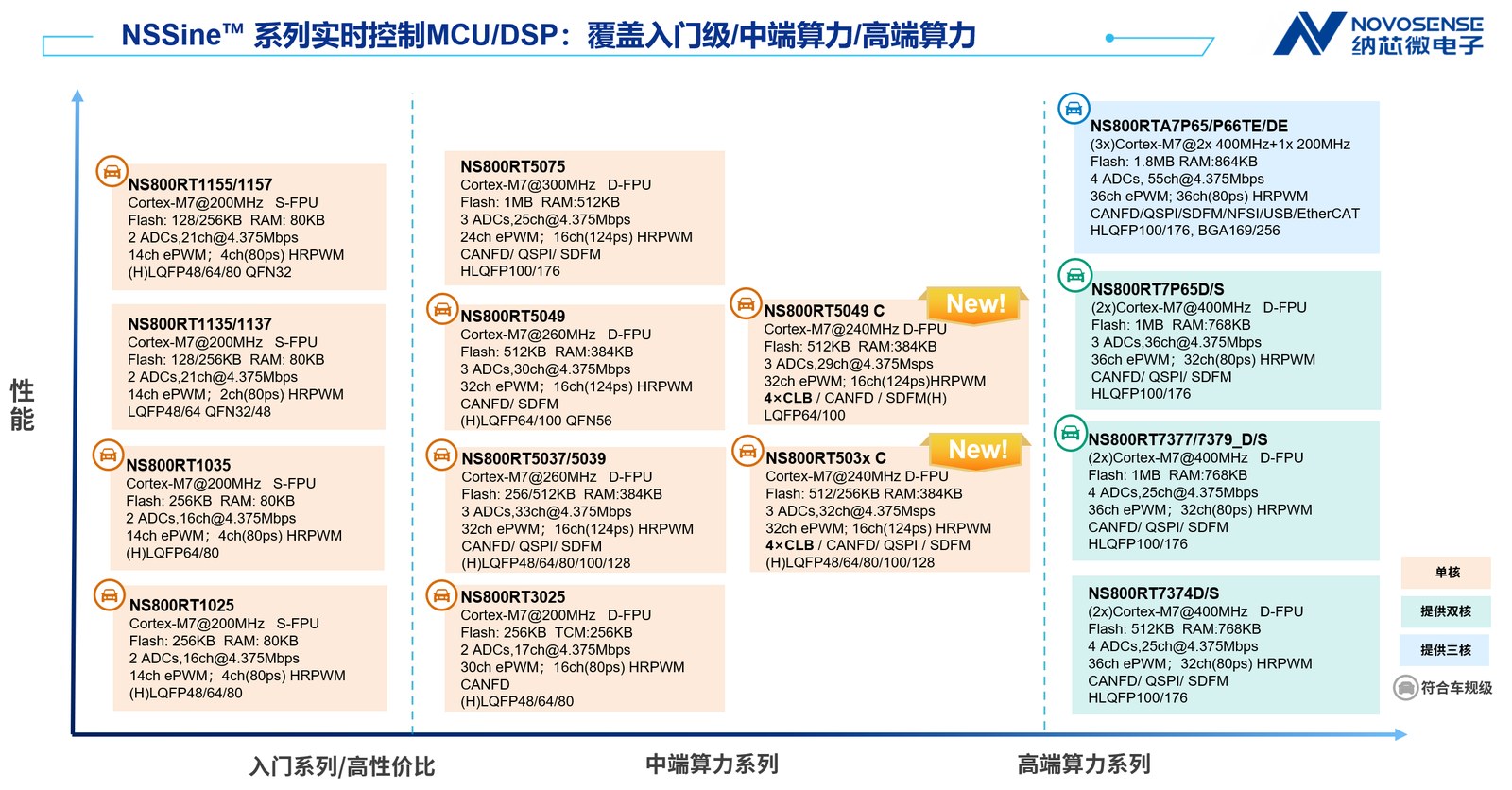
Official NSSine family portfolio from the same press package (via EETrend, November 5). The mid-range column marks NS800RT5049C and NS800RT503xC as New, both at 240 MHz* with 4×CLB*. Neighboring non-C mid-range boxes on the same chart still show 260 MHz*. Vendor marketing graphic, not a block-level silicon photograph.
Who the vendor is
Novosense — 苏州纳芯微电子股份有限公司, listed as 688052.SH in Shanghai and 02676.HK in Hong Kong — is a mixed-signal company whose public catalog is built around sensors, signal chain, and power management for automotive, renewable energy, industrial automation, and smart terminals. The NSSine real-time control MCU/DSP line is a newer pillar of that catalog: the platform was introduced around November 2024, and a May 2025 company note said the first industrial SKUs had reached volume after a first-pass silicon success.
CLB itself is not brand-new at the top of the same family. The company’s public selector already showed four CLBs on NS800RT5075 and six on NS800RT7374H, while the mid-range 5039 / 5049 / 5037 rows were listed with zero. What this launch changes is the middle of the stack: the C suffix puts four blocks on the 48- to 128-pin, 256/512 KB parts that a motor-drive or digital-power team is more likely to design in. That is a product-line observation from the official charts, not a teardowns-versus-datasheet conclusion.
What changes (and what does not)
What changes, if the silicon matches the graphics, is the mid-range BOM conversation. A servo, a PV or storage converter, an OBC, or a mid-voltage motor inverter that today carries a small external logic device just for encoder decode or PWM trip combinational logic now has a named Chinese M7 family that claims to absorb that job, with a graphical CLB tool and a sample email on the launch page. If you already evaluated NS800RT, the press note says the rest of the platform — tools, math accelerators, control peripherals — is meant to come along*.
What does not change is the homework. This is not a documented drop-in for a TI C2000 with CLB, even though the peripheral names rhyme; we have not seen a pin table, a memory map, or a software-compatibility claim in the materials we retrieved. Four configurable logic blocks are also not a spare FPGA: without a published resource count, you cannot assume your existing CPLD netlist will fit, or that every protocol variant will meet the same timing with the same software effort. The SRAM figure in the press copy does not match the official graphic. The C parts appear to run at 240 MHz* on that graphic, not at the 260 MHz* of the non-C mid-range. And there is still no Digi-Key catalog page. Get the datasheet, ask how big each CLB actually is, and measure the trip path you care about — then decide whether the CPLD footprint can come off the board.