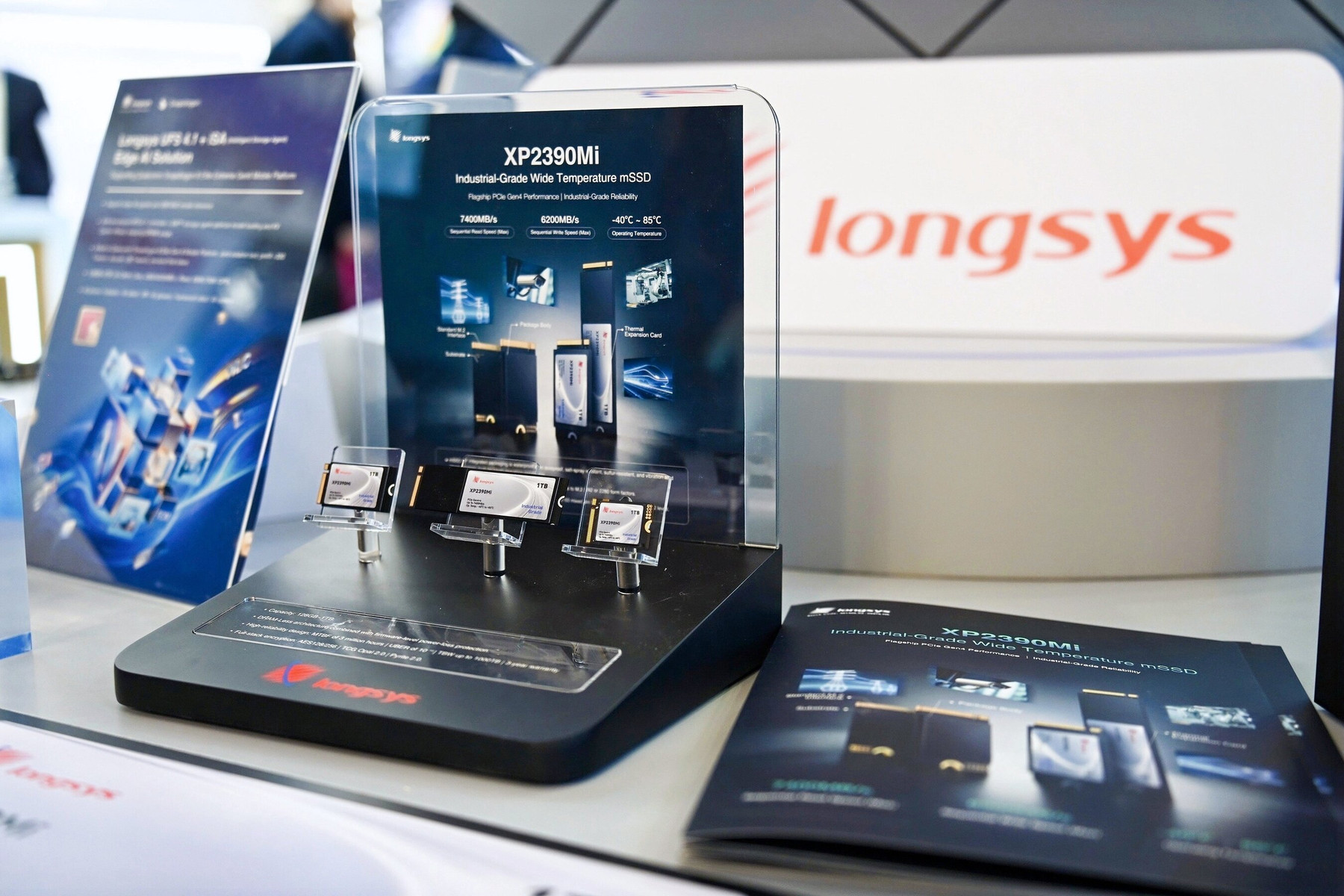
If you are specifying a compact Gen4 drive for an industrial PC, a battery camera, an outdoor controller, or a mobile robot, the useful question is not whether another Chinese SSD vendor showed up in Munich. It is whether Longsys has finally put a named industrial SKU on a form factor it already sells, and whether you can actually buy it. The Chinese PR Newswire note dated November 11, 2026, and datelined Munich answers the first part more clearly than the second.
The headline product is XP2390Mi, branded as an industrial-grade wide-temperature mSSD (Micro SSD). The official copy points it at industrial AI inspection, edge control, outdoor equipment, and embodied robots — anywhere a drive has to load a model or log data while the box is hot, cold, wet, or vibrating. That is a real socket. It is not, however, a brand-new mechanical idea invented this week.
What mSSD already was
On October 20, 2025, Longsys published an English note introducing what it called the industry’s first integrated-packaging mSSD, under an “Office is Factory” manufacturing pitch. The claim then — and the claim repeated this week — is system-in-package (SiP) assembly: controller, NAND, and passives in a single package, so the product does not go through a conventional SSD PCB and SMT line. The 2025 note said that design cuts board-level solder joints from “nearly 1,000” to zero*, and that it can move outgoing quality from a PCBA-grade ≤1000 DPPM story to a package-grade ≤100 DPPM story*. Those are company figures from last year, about the category, not a new lab report attached to XP2390Mi.
That earlier product was aimed more at PCs, handhelds, drones, and VR. The published envelope was 512 GB–4 TB*, sequential speeds up to 7400 / 6500 MB/s*, a 20×30×2.0 mm* body at 2.2 g*, and a clip-on thermal / length adapter that lets one module dress up as M.2 2230, 2242, or 2280*. The November materials do not repeat the 20×30 mm outline for the industrial SKU, so we are not copying it onto XP2390Mi.
What November 11 actually names
The new SKU is narrower, and more clearly industrial. From the November 11 release:
- Operating temperature −40 to 85 °C*.
- Interface PCIe Gen4×4*, protocol NVMe 2.0*.
- Capacity 128 GB to 1 TB* — a smaller range than the 2025 commercial mSSD, not a superset of it.
- Sequential read up to 7400 MB/s*, sequential write up to 6200 MB/s* (the backdrop on the booth stand prints the same pair; last year’s commercial note quoted 6500 MB/s write*).
- IP57* dust and water rating, plus vendor language for shock, vibration, and sulfur resistance*.
- Firmware-level power-loss protection* and unspecified “security mechanisms”*.
- Endurance on the 1 TB version: 600–800 TBW*.
- A thermal-expansion accessory, and the option to expand into M.2 2230, 2242, and 2280* lengths.
The booth photograph is more useful than the adjectives. Three physical 1 TB modules sit on the stand in three different lengths, and the backdrop art is labeled “Standard M.2 Interface,” “Package Body,” and “Thermal Expansion Card.” That is the 2025 adapter story, now shown as hardware you can pick up in hall C2. The SiP reliability argument is restated rather than newly measured: one package, fewer board-level solder joints, fewer SMT process steps. Treat IP57, the environmental adjectives, power-loss protection, and the 600–800 TBW band as claims to check against a datasheet and a qualification report — especially if you already buy industrial SSDs from Innodisk, Swissbit, or a similar catalog vendor that publishes those reports as a matter of course.
One thing the release does not give you is a public sample week, a distributor SKU, or a unit price. “Formally launched at electronica” is not the same as “orderable tomorrow on a Western cart.”
Not from a Western catalog click we could find — the published path this week is the Munich booth, then a Longsys sales contact. On November 11, 2026, we did not find a Digi-Key or Mouser product page for XP2390Mi. FORESEE, Longsys’s industrial / embedded brand, does appear on some electronics distributors in general (for example LCSC lists the brand), but that is not a listing for this SKU. The official invitation is booth C2.459 at Messe München, November 10–13. Longsys also owns Lexar, which already has a Western retail channel — that does not, by itself, put an industrial mSSD on a shelf. No public MOQ, lead time, or sample calendar appears in the materials we retrieved, and we are not inventing any. A booth stand with three modules is not a packing list.
The rest of the booth, in brief
The same release uses electronica to show a broader automotive and “edge AI storage” portfolio. These are adjacent products, not XP2390Mi, and a few numbers do not line up cleanly between the press text and the booth posters.
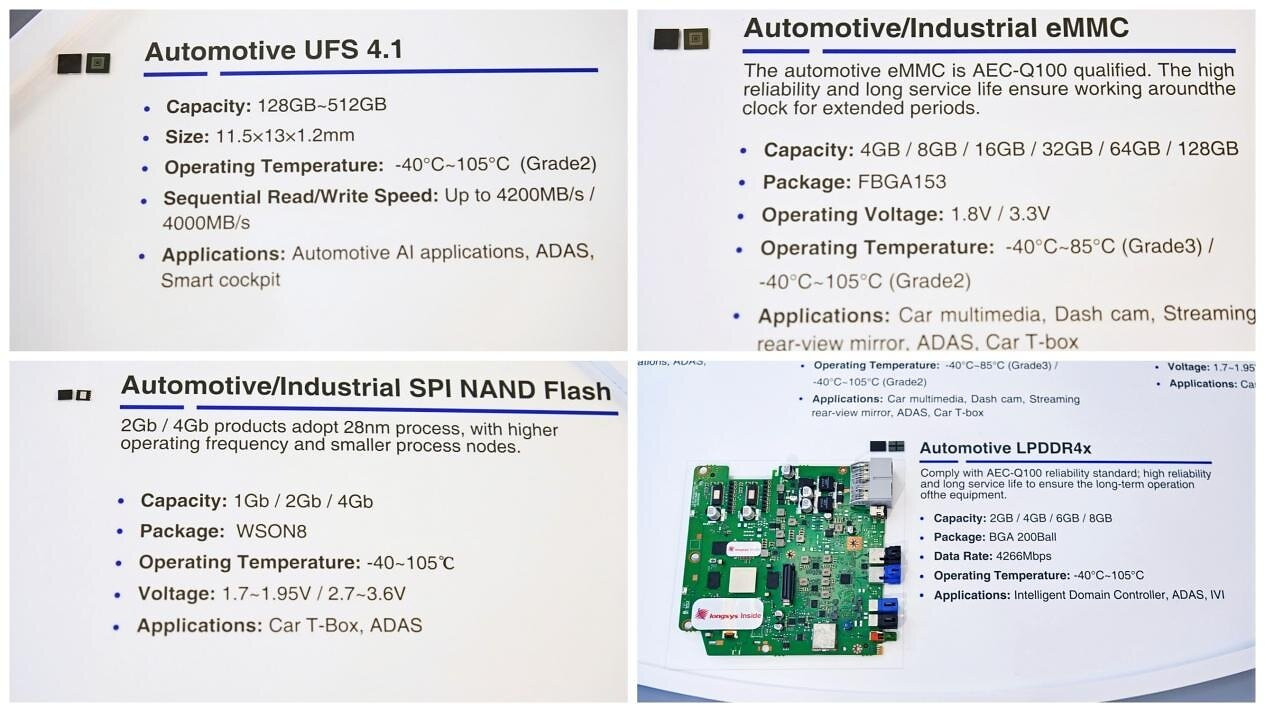
Official Longsys booth graphics from the same November 11 PR Newswire package: automotive UFS 4.1, automotive/industrial eMMC, SPI NAND, and LPDDR4x. These are vendor posters and a photographed evaluation board, not independent lab results. Note the eMMC capacity list on the poster is wider than the capacity range in the accompanying press text.
Automotive UFS 4.1* is the most concrete of the car parts: the release says it uses an in-house WiseMem (慧忆微) WM7400 controller on a 5 nm* process, 128–512 GB*, sequential speeds up to 4200 / 4000 MB/s*, and −40 to 105 °C*. The booth poster adds a package outline of 11.5×13×1.2 mm* and Grade 2 temperature language, and points the part at automotive AI, ADAS, and smart cockpit. A 5 nm in-house UFS controller is a supply-chain fact worth logging if you care who makes the controller, not only who brands the NAND package. It is still a vendor speed and temperature claim until a datasheet and an AEC-Q100 letter say so.
Automotive / industrial eMMC* is messier. The press text says the part uses a WiseMem WM6000 controller, capacities 32–128 GB*, and AEC-Q100 Grade 2 / Grade 3 options for −40 to 105 °C and −40 to 85 °C*. The booth poster in the same photo set lists 4 / 8 / 16 / 32 / 64 / 128 GB*, an FBGA153* package, and 1.8 V / 3.3 V rails*. Do not copy “32–128 GB” onto a spreadsheet without asking which SKU list is current. Automotive LPDDR4x* is given as 2–8 GB*, up to 4266 Mbps*, −40 to 105 °C*; the poster adds a BGA 200-ball* package. SPI NAND* is 1 / 2 / 4 Gb* in WSON8*, with dual-voltage 1.7–1.95 V and 2.7–3.6 V* and the same −40 to 105 °C* window. The poster also says 2 Gb / 4 Gb devices use a 28 nm process*. Longsys says this automotive line is qualified to AEC-Q100*, backed by in-house controller and firmware work, its own OSAT lines, and a claimed network of 20+ SoC platforms, 20+ vehicle OEMs, and 60+ Tier 1 customers*. Those customer counts are the company’s, not a design-win registry you can audit from the press page.
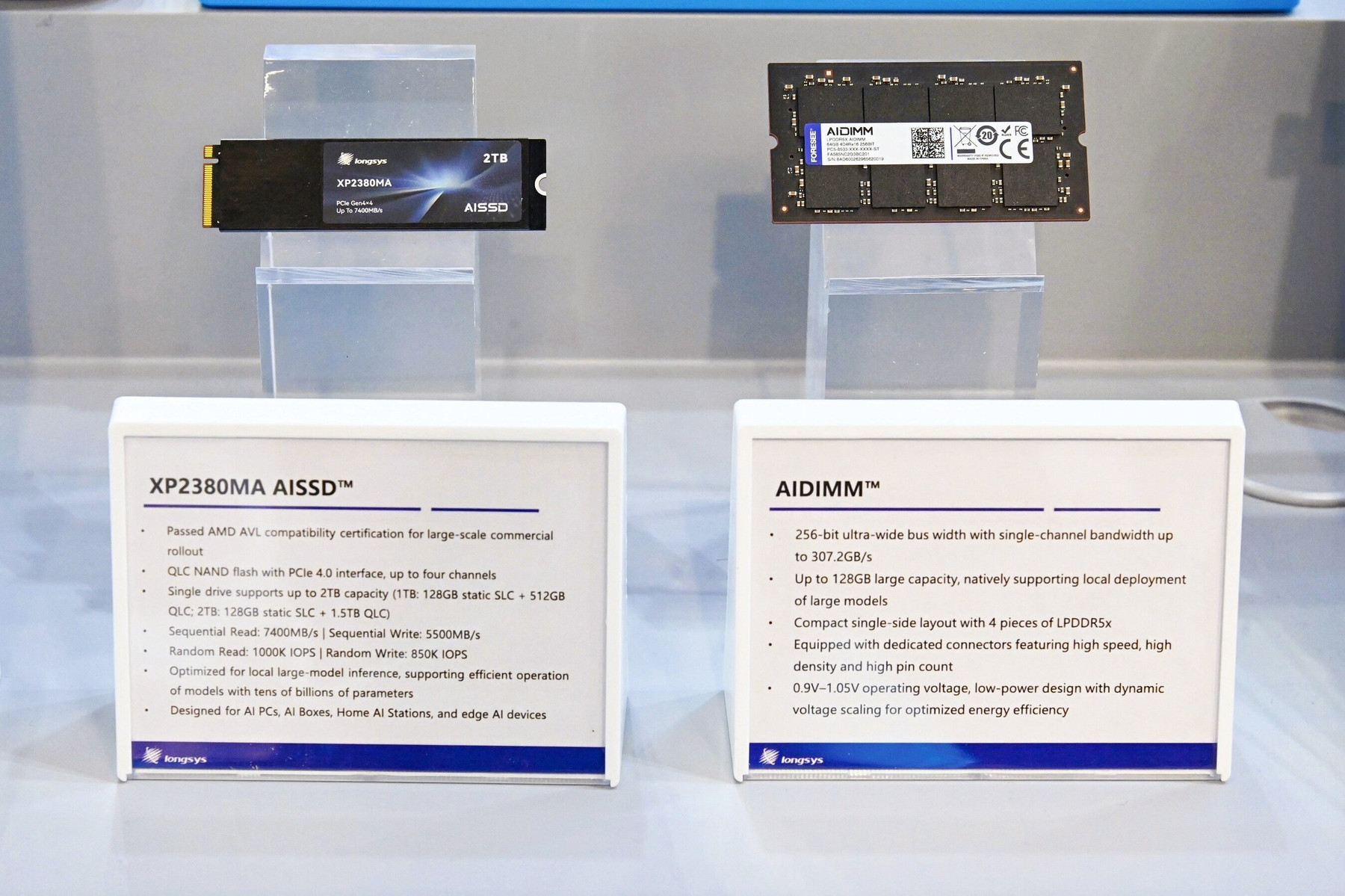
Official Longsys booth photograph from the same release: a 2 TB XP2380MA AISSD and an AIDIMM module, with vendor specification plaques. Product shots, not teardowns.
For edge-AI boxes and AI PCs, the company again showed XP2380MA AISSD* and AIDIMM*. The press text describes AISSD as a Static SLC + QLC stack, with a 128 GB Static SLC region (endurance up to 12,000 TBW*) for MoE expert weights, KV-cache offload, and prefetch, and a QLC region at 512 GB or 1.5 TB*. The booth plaque is more specific, and slightly different: it claims AMD AVL compatibility*, PCIe 4.0 up to four channels*, a 2 TB SKU as 128 GB static SLC + 1.5 TB QLC* (and a 1 TB SKU as 128 GB static SLC + 512 GB QLC*), sequential 7400 / 5500 MB/s*, and random 1000K / 850K IOPS*. Use the plaque as a booth graphic, not as a substitute for a datasheet; the write-speed and IOPS figures do not appear in the November 11 prose. AIDIMM is described as a plug-in high-bandwidth module with an LPDDR5x same-side layout, a 256-bit* bus, and up to 307.2 GB/s* — the plaque adds up to 128 GB* capacity, four LPDDR5x devices*, and a 0.9–1.05 V* rail. A related AILPBGA* (the booth poster spelling; the release uses the same trademark) is a 22×22 mm BGA1764* package with the same 256-bit / 307 GB/s* pitch, a poster capacity range of 24–64 GB*, and a standard LPDDR interface* so you are not supposed to re-spin the SoC. The release also quotes a 0.3 V operating-voltage figure* that the poster does not repeat; do not reconcile those by guesswork.
Finally, Longsys again showed HLCache* UFS, jointly tuned with Allwinner on an Allwinner A-series AI platform. The vendor’s prior test, restated this week, says that in a 30-app Chinese-software suite, a 4 GB DDR machine with HLCache kept 15 background apps alive instead of 7, and that average launch time across 20 apps was 850 ms versus 810 ms on a 6 GB DDR baseline*. That is a company demo on a specific platform, not a general “you can drop 2 GB of DRAM” rule.
What changes (and what does not)
What changes, if you are walking hall C this week or already talking to Longsys / FORESEE, is that the SiP mSSD now has a publicly named industrial SKU — XP2390Mi — with a wide-temp and IP57 story, a 128 GB–1 TB map, and physical modules on a stand in the three M.2 lengths industrial designers actually cut holes for. For a European machine builder who already likes the idea of a solder-joint-light module with a snap-on 2230/2242/2280 adapter, that is a reason to ask for the datasheet, the IP57 test report, the power-loss-protection behavior, and the 600–800 TBW conditions on the 1 TB part. The in-house WiseMem WM7400 UFS 4.1 controller is the other detail worth a follow-up if automotive storage is your socket.
What does not change is the homework, and the history. This is not a new form factor invented for electronica, and it is not a documented drop-in for an Innodisk or Swissbit industrial SSD you have already qualified. The 2025 commercial mSSD and this industrial cut do not share the same capacity range or the same write-speed headline. A few booth-poster numbers (eMMC capacity, AISSD write speed, AILPBGA voltage) do not match the press prose. We could not find a Digi-Key or Mouser page. Get the PDF for the exact SKU, ask when samples ship, and treat IP57, TBW, and “firmware-level PLP” as claims to verify — then decide whether this module belongs in the box.