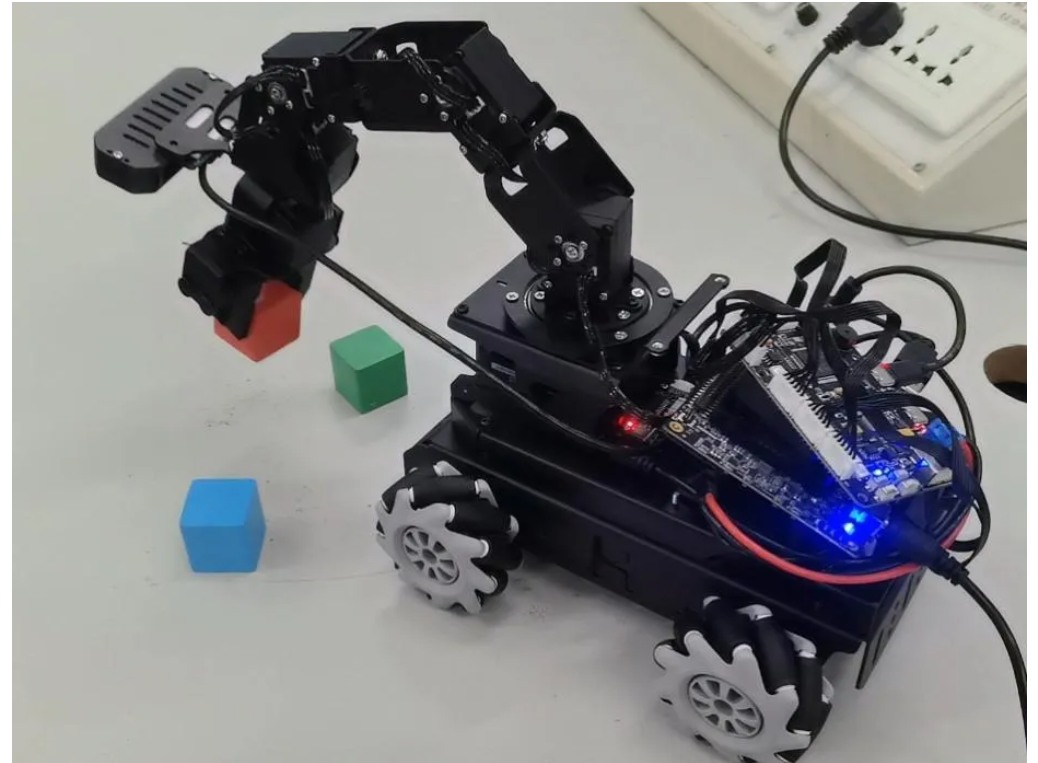
Most ROS 2 work still sits on x86 boxes or Arm boards. That is not a value judgment; it is where the packages, camera drivers, and MoveIt tutorials actually land. Loongson’s claim this week is narrower and more interesting than a new robot product: the company says it has finished a full-stack ROS 2 Jazzy port on a machine of its own, and that one 2K3000 now schedules the whole chain — 2D lidar mapping, joystick teleop, a six-axis arm, and a depth camera on the wrist that is used to grasp a target*.
Chinese-language reprints on November 10 and 11, 2026, attribute the announcement to Loongson. We did not retrieve a dedicated news URL on loongson.cn for this week’s ROS 2 note; the product page and an earlier official tape-out story are on that site, and the photographs used here come from Loongson’s own social post as carried by IT之家. Treat the stack description as a vendor demonstration until the image, the package list, and the camera/arm notes are in a public tree you can boot.
What the cart actually is
The vehicle in the photographs is a lab cart, not a warehouse SKU. The chassis rides on mecanum wheels, so forward, strafe, rotate, and diagonal motion come from mixing four motor speeds*. A USB gamepad plugs into the main board. Loongson wrote a small translator that turns stick deflection into velocity commands, with a dead-band and a safety enable, and a button that switches the same pad between the base and the arm*. The arm is a six-axis manipulator with a gripper; a Gemini depth camera sits on the wrist and moves with the tool, which is the textbook eye-in-hand arrangement*.
Perception is split on purpose. A lidar on the body does planar mapping; Loongson says it retuned the indoor parameters and fused odometry to keep the map edges and the pose more stable*. The wrist camera supplies color plus depth for the grasp. A target-detection model is said to have been run on the same Loongson platform*. After the base reaches a pose, MoveIt is the planner that is supposed to produce a joint trajectory — short, clear of obstacles, and directly executable*. The company also lists gamepad teach-and-replay: record a motion group once and play it back when the station changes, without rewriting the program*.
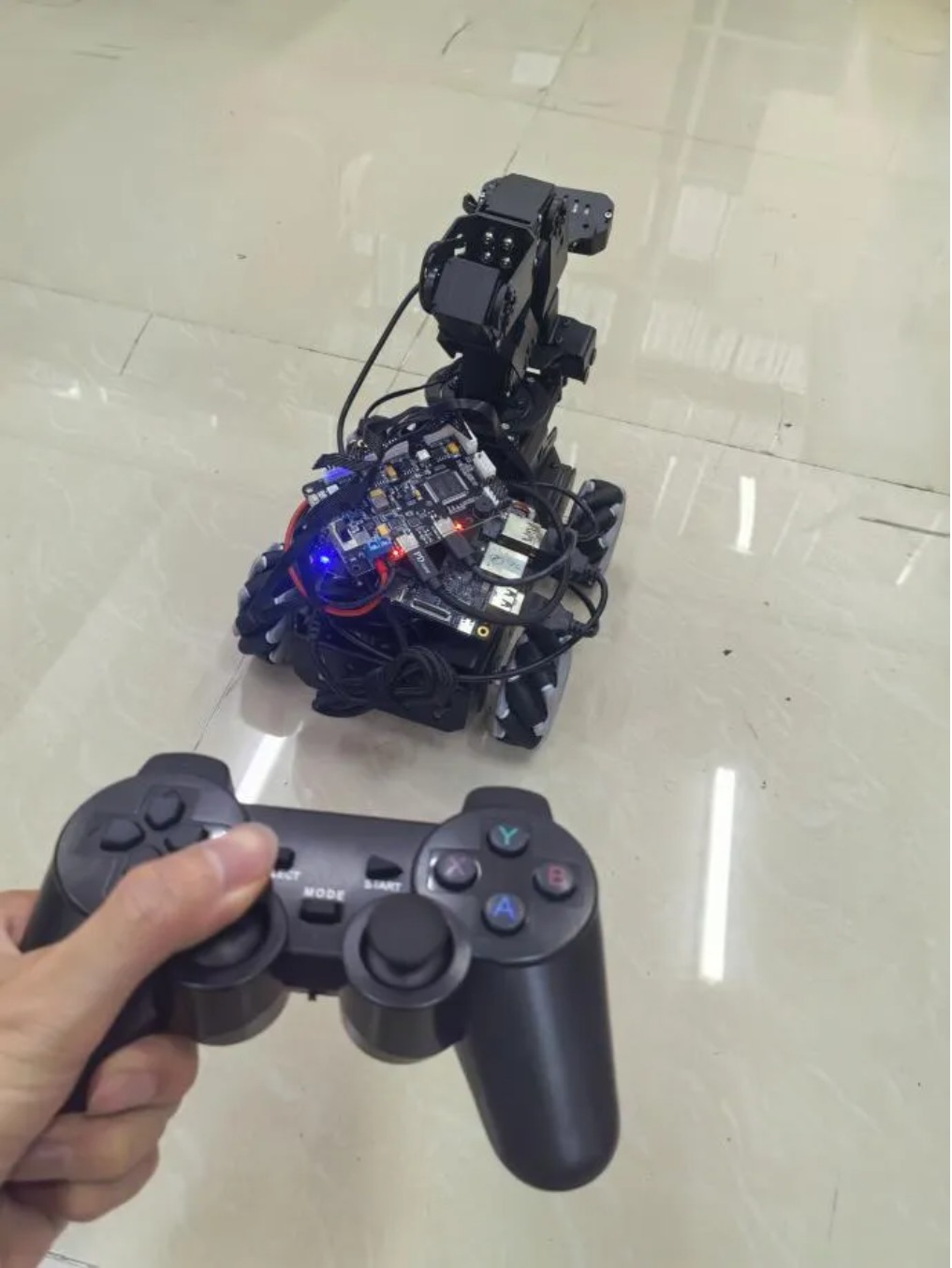
Official Loongson photograph from the same November IT之家 package: the USB gamepad in front of the demo cart. The reprints describe a six-axis pad mapping, a dead-band, a safety enable, and a one-key switch between base and arm*. This is the teleop path, not an autonomy screenshot.
The SoC was already on the page
None of that requires you to pretend the silicon is new. Loongson’s current 2K3000 product page already lists an eight-core industrial SoC on the company’s own LoongArch ISA. The useful numbers, as the page states them today:
- Eight LA364E cores, three-issue out-of-order*, 128-bit vector units*.
- Frequency listed as ≥2.0 GHz*. A April 3, 2025 official tape-out note — and this week’s reprints — cite a measurement at 2.5 GHz*. Use the datasheet for the part you are actually buying.
- L1 is 64 KB instruction plus 64 KB data per core*; L2 is a shared 6 MB*.
- One 64-bit DDR4 channel, or two 32-bit LPDDR4 channels*.
- On-die LG200 GPGPU: OpenGL 3.3, OpenGL ES 3.1, OpenCL 1.1*, and an AI rating of ≥6 TOPS INT8* on the product page. The 2025 tape-out note gave 256 GFLOPS FP32 and 8 TOPS INT8* for the same GPU block. Those two INT8 figures do not match; do not paste one into a spreadsheet without asking which revision the PDF describes.
- A hardware VPU listed up to 4K60*, display outputs eDP, DP, and HDMI*, with a product-page maximum of 4K@30 Hz* on the display line — another pair of numbers to reconcile in the manual.
- I/O that actually matters on a robot board: PCIe 3.0, SATA 3.0, USB 3.1, RapidIO 2.0, USB 2.0, GMAC, SDIO/eMMC, and CAN-FD*.
The same 2025 note is also the official source for a SPEC number people will quote: at 2.5 GHz, measured SPEC CPU 2006 Base single-core integer was 30 points*. The product page states the more abstract claim that single-thread SPEC CPU 2006 Base integer and floating-point peak exceed 10 points/GHz*, and that LA364E is in the same class as the LA464 core in the 3A5000*. Thirty points at 2.5 GHz is consistent with “more than 10/GHz.” It is still a 2006 suite, and it is still a vendor measurement. This week’s IT之家 write-up also compared the core to Arm Cortex-A76 and mentioned a 12 nm process; we did not find those two phrasing points on the official product page or the tape-out note we retrieved, so we are not repeating them as Loongson specifications.
One packaging fact is easy to miss and worth keeping straight: the 2025 note says 2K3000 and 3B6000M are different package versions of the same silicon — industrial versus mobile*. The user manual on the product page is titled accordingly. If a colleague hands you a 3B6000M datasheet, check the package and the I/O map before you assume it is a different design.
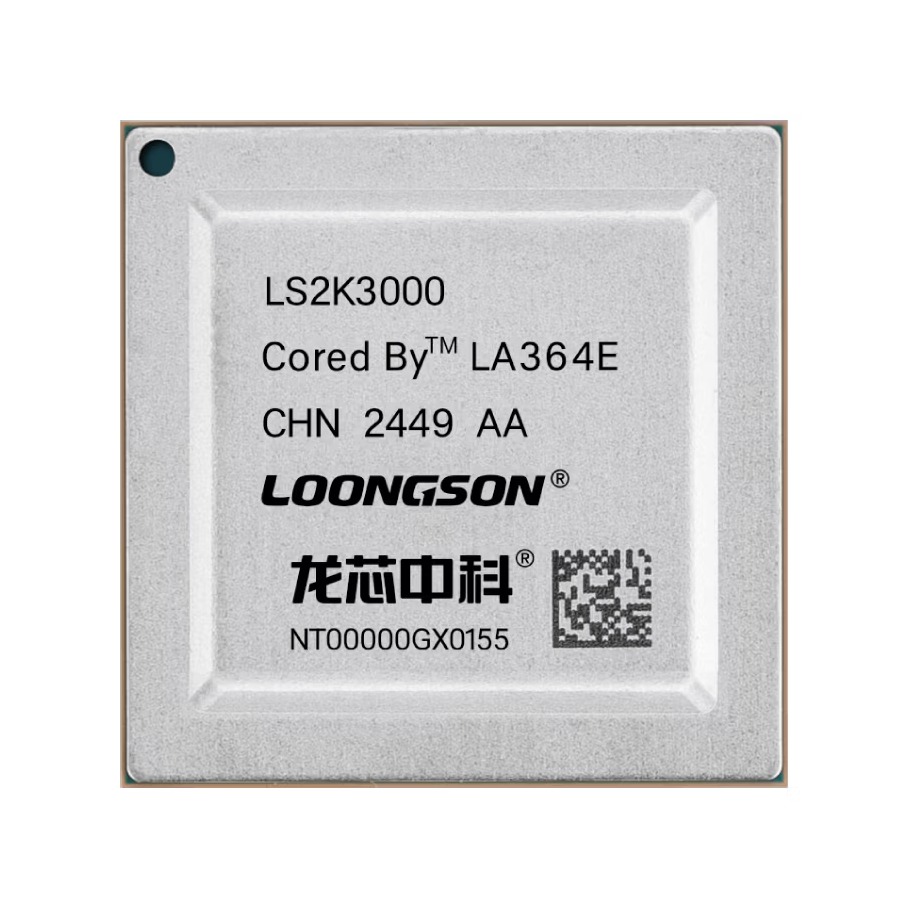
Official product photograph from Loongson’s 2K3000 page: an LS2K3000 package marked “Cored By LA364E.” This is the industrial SoC on the cart, not a new part number invented for the ROS 2 demo.
What the software screenshot is — and isn’t
One of the official photos is not the cart at all. It is a monitor showing RViz: the usual “2D Pose Estimate” / “2D Goal Pose” toolbar, a Unitree-branded humanoid model on a grid, and a joint-state publisher panel with sliders for hips, knees, and ankles. Reprints caption this as MoveIt running on the 2K3000, with an open-source Unitree humanoid model*. That can be a truthful description of a ROS visualization session. It is not a photograph of a Unitree humanoid walking on this chip, and it is not, by itself, evidence of a motion-plan on the six-axis arm in the other pictures. Keep the two images separate. The physical demo is the mecanum cart and the cubes. The screenshot is software-stack atmosphere.
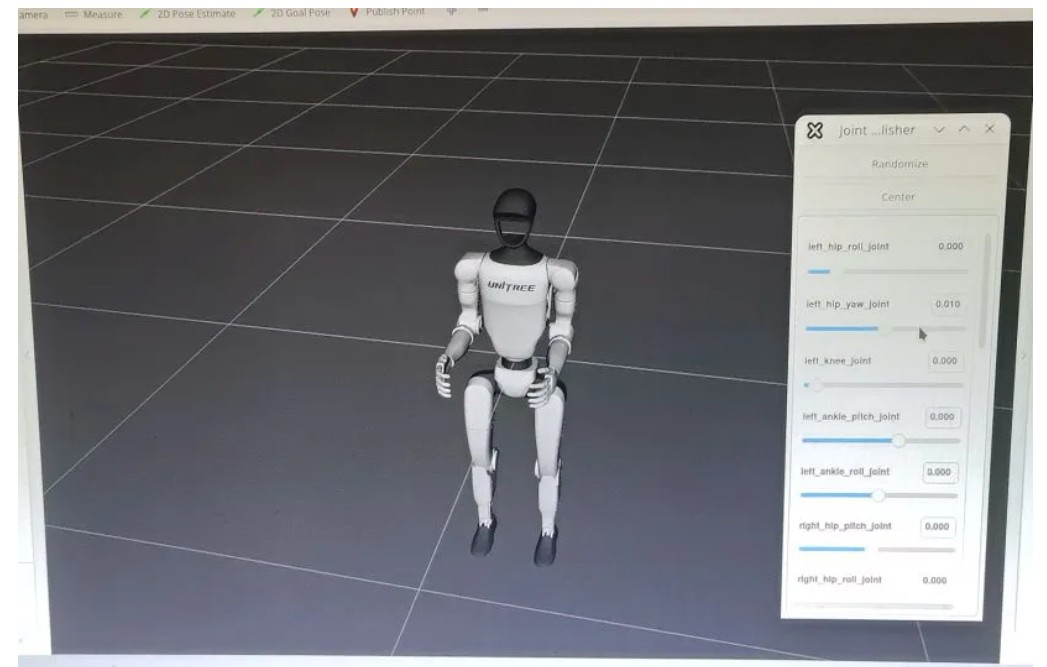
Official Loongson photograph from the same IT之家 set, captioned in reprints as MoveIt on the 2K3000 with an open-source Unitree humanoid model in RViz*. The visible UI is RViz plus a joint-state publisher. This is a software screenshot, not the physical demo vehicle.
You can inquire about 2K3000 boards. This cart is not a catalog robot, and we did not find a public ROS 2 image you can just apt-install. The SoC is a current Loongson industrial part, with a user manual and datasheet dated August 2026 on the product page, and Loongson has previously said industrial and information-equipment makers were already designing it in. That is not the same as a Digi-Key or Mouser click for a 2K3000 ROS kit — we did not find one. We also did not find a public git repository, apt source, or BSP note for this exact Jazzy port in the materials we retrieved, and we are not inventing one. If you already have a 2K3000 industrial PC, this week’s post is a reason to ask Loongson for the ROS 2 image, the lidar and Gemini camera notes, and the MoveIt package list. Loongson itself says emergency-stop and watchdog support still have to be added, that motion groups still need to be wired into upper-level programs, and that detection-plus-point-cloud 3D localization is future work*. A demo that still owes you an e-stop is a prototype, not a cell you put on a line.
What this changes, and what it does not
It does not change the default robotics stack tomorrow. Jetson, x86 industrial PCs, and the usual Arm SBCs remain the path of least resistance for anyone who needs a driver that already exists and a forum thread that already names the error. A vendor cart that picks up colored cubes is also not a claim about cycle time, payload, or ISO safety.
What it does change is the answer to a more specific question: can ROS 2 Jazzy, including the mapping / teleop / MoveIt / wrist-camera path people actually use for a mobile manipulator prototype, be brought up on LoongArch silicon that you might already be qualifying as an industrial PC? Until this week the honest answer, for most overseas engineers, was “maybe, if you enjoy porting.” Loongson is now saying it has done that work on one vehicle and is willing to show the photographs. That matters if you are already looking at Loongson boards for a China-sited AMR, a teaching cell, or an ISA-diversity experiment. It does not, by itself, make 2K3000 a substitute for a supported robotics kit.
The homework is the same as it is for any vendor-port story. Ask for the image and the package list. Ask which Gemini camera, which lidar, and which motor drivers they used. Reconcile the frequency, the LG200 TOPS line, and the display-rate wording against the August 2026 datasheet. Confirm that e-stop and watchdog landed before anyone treats this as more than a lab cart. Then decide whether LoongArch is a constraint you have to live with — or just an interesting weekend port.