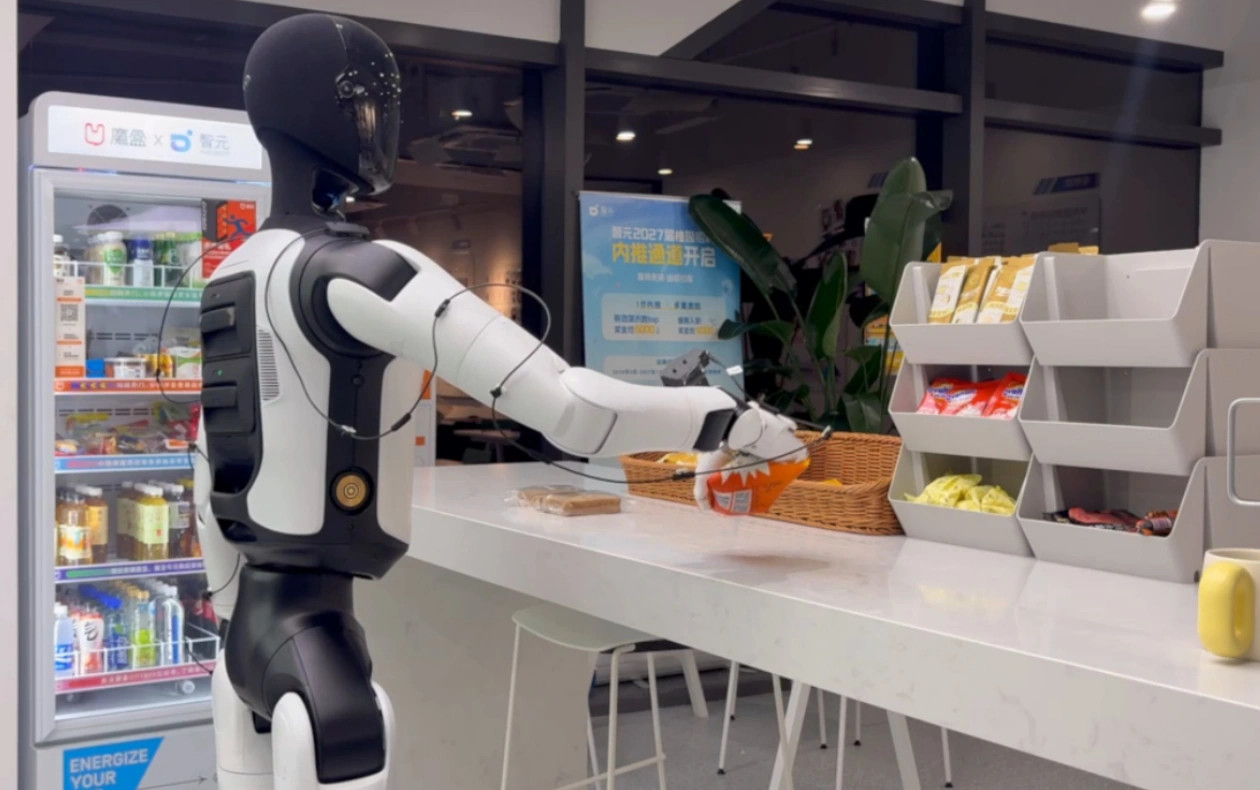
Most robot stacks are organized around a single instruction: perceive, plan, act, then reset. The physical world does not reset. Elevator doors open, a visitor arrives, a cup changes hands, all while the policy is between goals. LIFE, from AgiBot’s HI / 远征 research team, is an attempt to treat that in-between time as the product. The report and the project site describe three cooperating pieces around a multimodal agent: RoboBeats (a light streaming gate), Plastic Memory (a flat store of selected images plus JSON records), and Explore–Distill–Mount (EDM), reused from the team’s earlier ReSight work, which turns a working procedure into a validated tool.
RoboBeats is the part you can actually download as a model. It is a family of LoRA adapters on Qwen3.5-0.8B / 2B / 4B, hosted as superbigsaw/RoboBeats-2B and the matching 0.8B and 4B cards. The gate reads a 1 fps (1 Hz) causal video stream and, instead of writing a caption for every frame, reads true/false scores for natural-language conditions — “has the elevator door opened?”, “has a new event just occurred?”. Multiple conditions share the visual tokens and cached history and keep their own prediction state. The 2B card’s example selector opens an event when the score is above 0.5 and closes it below 0.3. Only frames around those events are meant to be written into memory. The site’s official office demos overlay exactly this: a first-person fisheye next to a third-person shot, with the monitored condition and the triggered action on screen.
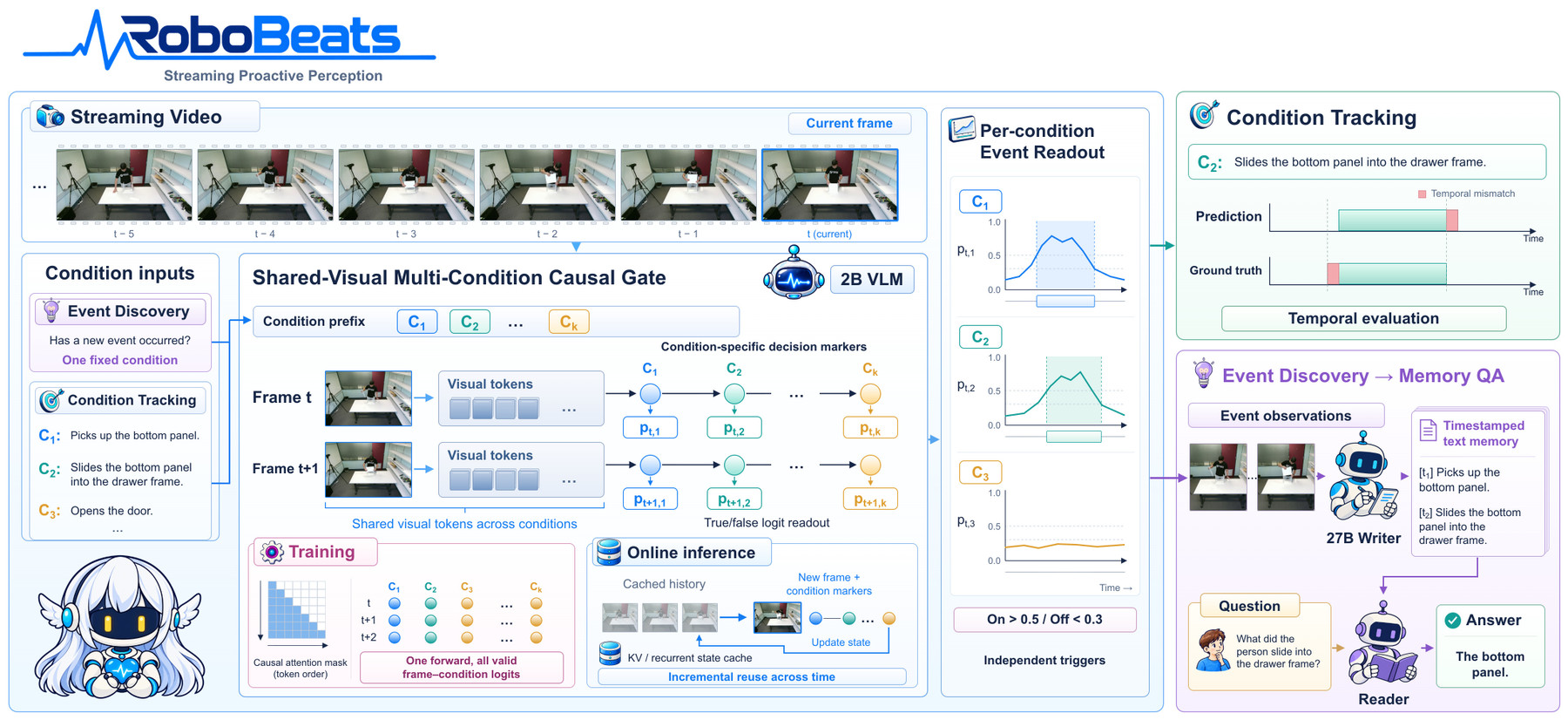
Official RoboBeats architecture figure from the LIFE project site (assets/s2-research/robobeats.webp), corresponding to the paper’s Figure 4. Company diagram, not artwork we drew.
Plastic Memory is deliberately boring, which is the point. Selected frames are kept as files, with a JSON record for time, optional pose, and extracted fields for people, objects, and events. Because the original image is retained, a later question can harvest a detail — a room number on a door, whose cup that was — that nobody extracted when the frame was first saved. EDM sits on top when the current toolbox is not enough: an encoding agent explores a procedure, distills out scene-specific hard-coding, and mounts the result so the execution agent can call it later. The paper is explicit that this is skill and tool construction, not a requirement that the base model’s weights be updated after every task.
The repo, yes — the weights, only if CC BY-NC works for you. AgibotTech/LIFE is Apache 2.0. The three RoboBeats adapters on Hugging Face are labeled cc-by-nc-4.0, and the README says SSS-Bench data and rubrics are also CC BY-NC 4.0; source videos stay under their original providers’ licenses and are not in the same dump. You will also need the Qwen3.5 base checkpoints the LoRAs sit on, and a CUDA GPU: the README’s default torch==2.13.0 wheel is built for CUDA 13 and asks for NVIDIA driver ≥ 580; a CUDA 12.9 install path is documented for 12.x drivers. We did not run the stack. This is research code plus a non-commercial gate, not a robot you can add to a cart, and not a license we can interpret as permission to ship a commercial product on top of the adapters.
What the paper actually measures
The useful numbers are protocol-bound. Treat them as the authors’ results, not as something we reproduced.
- StreamingBench, proactive-output (PO), ±2 s first-trigger accuracy: RoboBeats-4B reaches 64.0%, against 21.2% for the untuned Qwen3.5-4B base under the paper’s condition-judgment protocol (Table 2 and Appendix B.3). IT之家 quoted the same pair.
- SPOT-Bench, action-boundary T-F1@5: RoboBeats-4B reaches 45.8, against 26.4 for Qwen3.5-4B in the same appendix table. RoboBeats-2B is 43.8, against 27.5 for its own 2B base (main text, Table 2).
- SSS-Bench (618 questions from 171 parent videos, six sources, 14 subtypes; answers may use only evidence from before the question time). Under the text-memory-only setting with a matched write budget and the same writer/reader, RoboBeats-2B is at 60.5%, versus 40.9% for a Qwen3.8-27B selection baseline and 46.5% for uniform sampling. In the setting that also allows up to 10 historical frames, and only on videos with at least 20 minutes of observation, RoboBeats-2B reaches 58.6%, 5.2 points above uniform sampling — the comparison the project site highlights.
- FindingDory / ReSight EDM: on 597 held-out queries (episodes 81–90, capabilities frozen at test), success goes from 37.5% without EDM to 65.8% with it, and mean tokens per query from 128.8k to 39.4k (paper Table, ReSight-Sol). This is ReSight’s original experimental protocol, reported in the LIFE paper because LIFE mounts that mechanism — not a new in-the-wild AgiBot deployment we can vouch for.
- 24-hour office case study: the team built memory offline from 24 hours of video collected by an A3 Ultra in an office, then asked six questions, three runs each, with the same GPT-6.1-sol answering model. LIFE scored 29.5 / 30 at a mean 80.6 seconds per answer; a coding agent given the constructed memory (Codex B) scored 28.5 / 30 in 554.7 seconds; a coding agent given the raw video and registration materials (Codex A) scored 24 / 30 in 961.5 seconds. Those times exclude memory construction. The paper calls this a case study of limited scale; the project site says it does not show that long-term online autonomous learning has been validated.
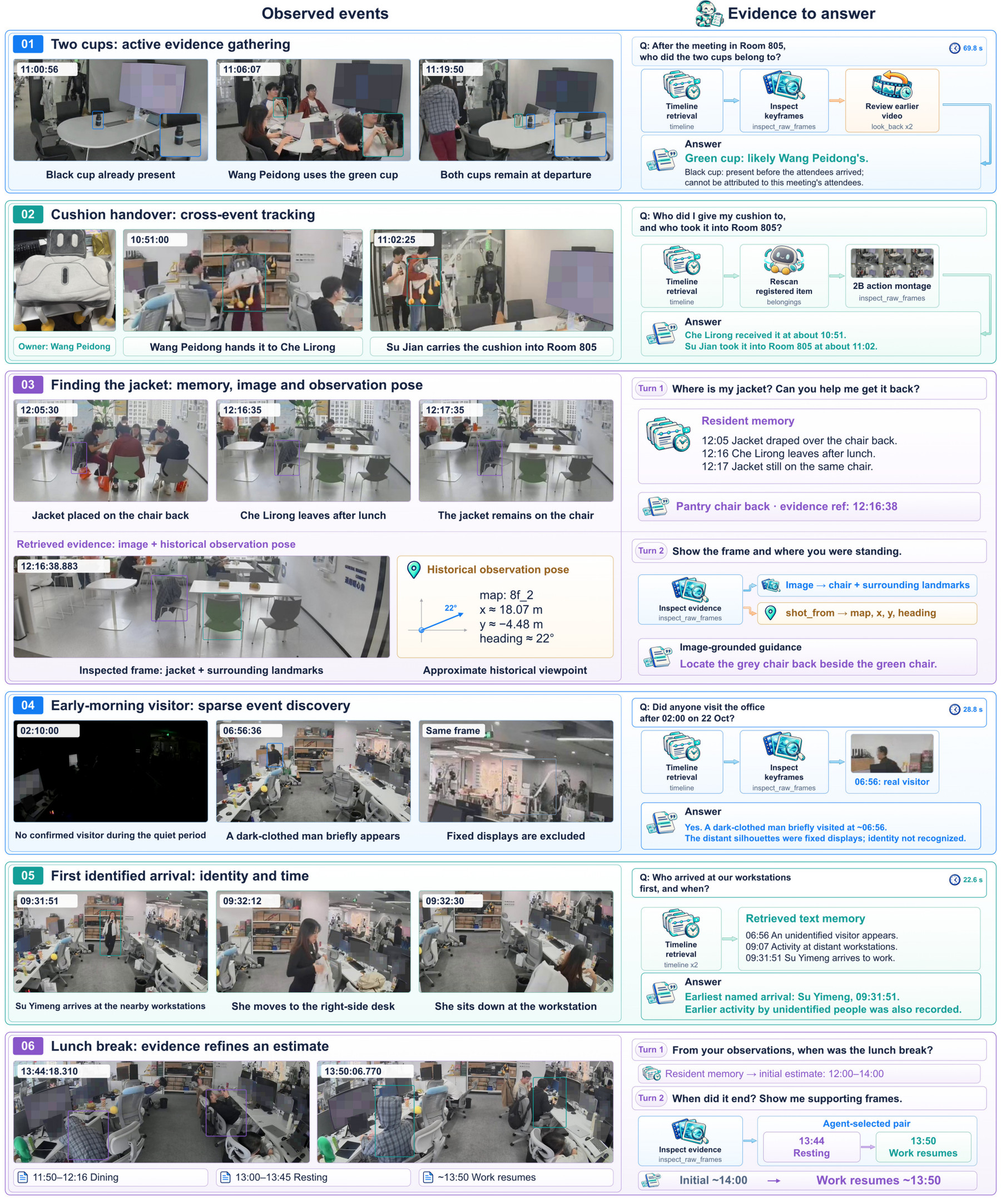
Official six-case figure from the LIFE project site (assets/s2-research/robot-cases.webp, paper Figure 13): offline memory built from a day of A3 Ultra office video, then used to answer later questions. Company figure, not our screenshot of a run.
Honest caveats
- Weights ≠ code. Apache on the repository does not make the RoboBeats adapters or SSS-Bench data commercial-friendly. Read the CC BY-NC files before you fine-tune, host, or ship anything.
- Not a robot SKU. There is no Digi-Key or first-party storefront link in the release. The official demos and the 24-hour study use AgiBot hardware (the day-long recording is named as A3 Ultra); the open drop is software and weights.
- Vendor and paper benches. We did not rerun StreamingBench, SPOT-Bench, SSS-Bench, FindingDory, or the six office questions. Gains depend on the listed protocols, write budgets, and reader models.
- Offline is not lifelong. The 24-hour study replays recorded video to build memory, then asks questions. The authors say later work still needs multi-day online deployment and an assessment of memory updates in a changing environment.
- Local cost. Official inference assumes a recent NVIDIA stack (CUDA 13 by default). The 4B adapter is still a LoRA on a small base, not a 70B local brain, but you will be pulling Qwen3.5 bases and, for SSS-Bench reproduction, a separate judge/writer such as Qwen3.8-27B.
For an overseas engineer, the clean split is this. If you want a small, causal gate that watches 1 fps video and decides when a frame is worth remembering, the code and the three LoRAs are public, the serving command is one line, and the research question — what should a robot do with the hours when nobody is issuing a task — is a real one. If you want to productize that gate, start with the CC BY-NC label, not with the Apache badge on the repo. And if a social post tells you AgiBot has “solved lifelong learning,” the paper’s own 24-hour section is the corrective: a careful offline case study, not a robot that has been living in a room for a month.